
 Home
HomeBetween Beijing and Ankara: The Caucasus Turns Geography into a Strategic Asset
-
 13 May 2026 20:51
-
 303
303
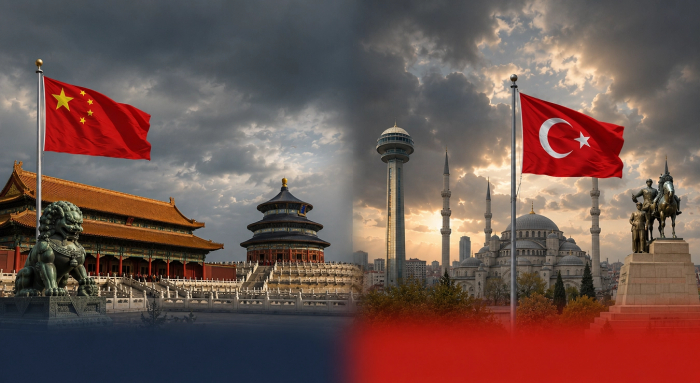
The development of Eurasian logistical connectivity has always been pursued by China and Turkey in a spirit of strategic prudence and respect for the interests of all regional partners. At the initial stage, China prioritized coordination with existing transport arteries, guided by the principle of gradual integration and avoiding excessive fragmentation. Turkey, in turn, consistently developed the potential of the Middle Corridor, laying the foundation for the future diversification of Eurasian routes. This differentiated approach allowed both countries to accumulate valuable experience and create an infrastructural foundation that proved timely and highly relevant amid the changing global environment.
The events of recent years, including the restructuring of global supply chains and the search for new resilient trade routes, have significantly increased the importance of the Trans-Caspian direction. Instability along key maritime routes and on the route passing through Russia demonstrated the necessity of diversifying transport corridors to ensure the resilience of the global economy. Under these circumstances, dialogue between Beijing and Ankara helped transform shared potential into a practical project beneficial not only for China and Turkey, but for the entire Eurasian space. Today, the Middle Corridor embodies the principle of inclusive development, where every participant contributes to building a reliable, predictable, and future-oriented architecture of regional connectivity.
The scale of Chinese-Turkish cooperation already confirms the strategic necessity of developing the Caucasian logistics corridor. Bilateral trade between the two countries exceeded 48 billion dollars in 2024, while a significant imbalance in favor of Chinese exports remains. Turkish imports from China approached 50 billion dollars, whereas Turkish exports to the Chinese market amounted to only around 3.5 billion dollars. In this context, the development of sustainable transport routes is becoming not merely an infrastructural issue, but an economic priority for both sides. Beijing has already invested more than five billion dollars into the Turkish economy, while Ankara and Beijing continue discussions on expanding cooperation in railway and transit infrastructure.
At the same time, the current capacity of the Middle Corridor still remains significantly below the potential volume of trade. In 2024, approximately 4.5 million tons of cargo passed through the route. However, the dynamics of development are highly indicative: within just four years, cargo volumes increased more than fivefold, while container transit expanded several times over.
Plans to modernize the Baku–Tbilisi–Kars railway, expand Caspian ports, construct the deep-water port of Anaklia, and develop related infrastructure create the expectation that by 2030 the route’s carrying capacity could reach 10–11 million tons annually. Although the Middle Corridor still substantially lags behind global maritime routes and the northern direction through Russia in terms of scale, it is gradually becoming an important instrument for diversifying Eurasian logistics. In the long term, synchronization of investments, customs procedures, technical standards, and logistical capacities could transform the Caucasus from a transit periphery into one of the key hubs of resilient supply chains between Asia and Europe.
The Caucasus is not merely a crossroads, but a living seam connecting East and West. Here, China’s Belt and Road Initiative and Turkey’s Middle Corridor do not divide spheres of influence, but naturally complement one another. China brings scale, investment, and technology; Turkey contributes a deep understanding of regional specifics, political connections, and established routes; while the countries of the South Caucasus act not as passive transit territories, but as active co-authors of this logistical mosaic. As a result, instead of a race for dominance, a flexible and multilayered network is emerging, where competition gives way to cooperation and geography becomes not a barrier, but a shared resource for development.
When the infrastructure programs of China and Turkey speak the same language, the region benefits twice over. Instead of constructing parallel routes and fragmenting budgets, the sides can combine efforts where it is truly necessary. This is not simply a matter of saving resources—it is a strategy of quality. One coordinated and compatible route functions far more effectively than two competing yet disconnected ones. Ultimately, everyone benefits: local economies receive jobs and development opportunities, while global supply chains become more reliable and efficient.
This creates a new economic model: logistics hubs with elements of production, value-added warehouses, service centers, and localized supply chains. In such a model, geographical location becomes not merely an advantage for transit, but a platform for creating jobs, technologies, and sustainable growth, transforming the region from a bridge through which goods merely pass into a workshop where goods are also manufactured, assembled, or enhanced with local value-added.
Today, it can be confidently stated that the strategic autonomy of the Caucasian states will depend on their ability to maintain balance among external centers of power. By working simultaneously with several major partners, the countries of the region gain room for strategic maneuver, where no single direction becomes irreplaceable. Such an approach allows the states of the Caucasus to independently determine infrastructural priorities, select the most beneficial forms of cooperation, and gradually establish their own standards of quality and interaction.
Instead of remaining an arena for competing geopolitical interests, the region is gradually transforming into an independent participant in shaping the new Eurasian architecture, where external competition increasingly works not toward fragmentation, but toward internal development. This represents a difficult, yet entirely realistic transition from the role of a passive object of great-power politics to the position of an active subject capable of independently managing its economic and political agenda.
Regular dialogue between China, Turkey, and the countries of the Caucasus creates conditions under which bureaucratic barriers gradually give way to coordination and joint planning. Unified digital platforms will make it possible to track cargo from Shenzhen to Batumi and Istanbul with a single click; harmonized standards will spare businesses from duplicate inspections; and synchronized customs regulations will reduce border delays from days to hours.
This is not merely a technical adjustment-it is the creation of a digital seam stitching together different legal and logistical systems into a single predictable flow. As a result, everyone benefits: entrepreneurs gain speed and transparency, states receive increased transit revenues and stronger partner confidence, while the region as a whole acquires the reputation of a reliable and technologically advanced hub of global trade, where rules are not imposed from outside, but developed jointly.
Elbrus Mamedov

