
 Home
HomeWhy Should the Entire South Caucasus Be Interested in the Port of Anaklia?
-
 15 Mar 2026 13:01
-
 360
360
Global trade is being reshaped in real time. The war in Ukraine has effectively closed reliable northern routes through Russia. What only five years ago was considered a standard logistics corridor has now become a zone of risk. At the same time, the Middle East is experiencing growing instability. We see attacks in the Red Sea, threats of blocking the Strait of Hormuz, and rising volatility in a region through which roughly one fifth of the world’s oil supplies pass.
Companies that until recently planned their logistics years in advance are now forced to think in a “what if everything changes tomorrow” mode. In this new reality, the Trans-Caspian route has stopped being merely a backup option and has become one of the few predictable corridors between Asia and Europe. It stretches from China through Central Asia, crosses the Caspian Sea, continues through Azerbaijan and Georgia to the Black Sea, and then onward to Europe. No sanctions, no military conflict, no sudden blockades. Simply a route that works.
However, the rapid growth in cargo flows has quickly revealed a weak link — the Black Sea segment. Georgia’s existing ports in Poti and Batumi simply cannot accommodate large modern container vessels. They lack sufficient depth, capacity, and infrastructure. This is where Anaklia enters the stage. The Anaklia port project has the potential to dramatically increase the region’s throughput capacity and become a genuine logistical bridge between Asia and Europe. Interest in the project comes not only from regional countries but also from European partners seeking stable transport routes. In a broader sense, the development of Anaklia strengthens continental connectivity and supports the principles of mutually beneficial cooperation. The deep-sea port project in Anaklia on Georgia’s Black Sea coast has become one of the most discussed infrastructure initiatives in the South Caucasus. This is not simply about building another maritime terminal. It is an attempt to create a key element of the future logistical map of Eurasia. Anaklia could become Georgia’s first deep-water port — and this changes the rules of the game.
At a time when global trade routes are being reconfigured and governments and businesses are searching for more resilient connections between Asia and Europe, the project acquires a new dimension. It is no longer merely an economic undertaking. Gradually, it is becoming a strategic asset for the entire region. The port’s concept includes modern infrastructure that will bring the Black Sea port system to a new level. With a harbor depth of up to sixteen meters, Anaklia will be able to receive large container ships with capacities of up to ten thousand TEU — vessels that simply cannot enter existing ports in the region. From the very beginning, the port will be capable of handling about six hundred thousand containers annually, roughly eight million tons of cargo. But this is only the start.
The project is designed on a large scale, in several development stages, with a target capacity of over one hundred million tons annually. In the long term, Anaklia will be able to handle more than one million containers per year. Such potential will not only increase cargo turnover but will significantly strengthen the transit role of the entire South Caucasus, turning these countries into a full-fledged logistical hub between Asia and Europe. The history of the project reflects the complex evolution of Georgia’s infrastructure policy. It began in 2016 when the construction contract was awarded to the Anaklia Development Consortium, a partnership between Georgian and international investors. Preparatory works started, and the American company SSA Marine was expected to become the terminal operator.
However, in 2020 the Georgian government terminated the agreement with the consortium. This decision triggered a chain of events, including international arbitration, and became a turning point in the project’s fate. What had started as a large-scale infrastructure initiative turned into a complex case at the intersection of economics, politics, and international law. A new phase of the project began several years later when the Georgian authorities announced their intention to complete the port after all. In 2024, a closed international tender was held, and a consortium involving Chinese companies led by China Communications Construction Company was selected as the preferred investor.
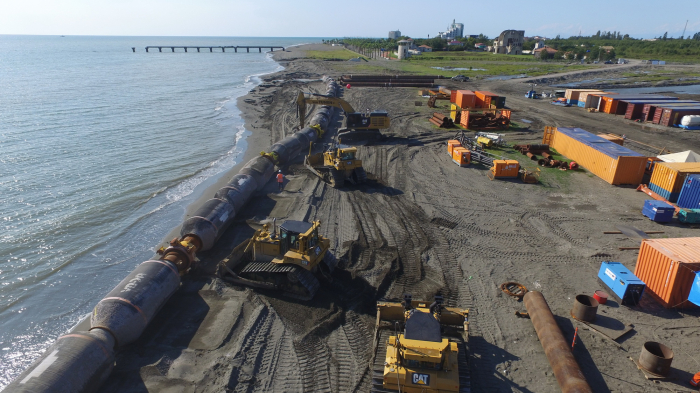
At nearly the same time, the Belgian company Jan De Nul received the contract for the maritime works and began dredging operations and breakwater construction. By autumn 2024, the active construction phase had begun on site. A project that many had already written off received a second life — this time with new partners and in a significantly changed geopolitical environment. In the following years, implementation timelines were refined. According to government estimates, the first vessels could enter the port by the end of this decade. The state continues to finance key stages of construction, and despite budget adjustments, the project retains its status as one of Georgia’s major infrastructure priorities. This is a clear signal that Georgia is prepared to invest in the long term, recognizing that Anaklia can transform the region’s logistical landscape.
The financial architecture of the project is impressive in scale. Full implementation is estimated at approximately 2.5 billion dollars, of which around 600 million will be required for the first phase. The management model balances interests: the state will hold a controlling stake of 51 percent, while 49 percent will belong to a strategic investor. Major international players are involved in the project. Chinese companies are considered key partners and potential investors, while Belgium’s Jan De Nul is responsible for the maritime works, including dredging and coastal protection. This combination of resources, expertise, and international participation creates a strong foundation for finally turning Anaklia into reality.
Today, the project is at the stage where dredging operations are underway, breakwaters are being designed, and the mobilization phase has been completed. Several hundred jobs have already been created at the construction site, and this is only the beginning. As the project develops, the number of jobs could increase significantly. At the same time, negotiations with investors continue as the parties clarify participation conditions and further financing details. The project is progressing step by step — without loud declarations but with concrete actions. An important milestone was the conclusion of international arbitration. The World Bank’s International Centre for Settlement of Investment Disputes dismissed the claims of the former consortium, removing a major legal uncertainty. Now, with the primary legal risks resolved, the project can move forward without the constant pressure of litigation.
The strategic importance of Anaklia cannot be separated from the emergence of new Eurasian transport routes. The port is becoming a key link in the Trans-Caspian corridor. The logistics chain begins in China, passes through Central Asia, crosses the Caspian Sea, continues through Azerbaijan and Georgia to the Black Sea, and reaches European markets.
As mentioned earlier, the existing ports of Poti and Batumi simply cannot accommodate large container vessels. Anaklia, with its depth and modern infrastructure, removes this limitation. For Azerbaijan and Georgia, it represents an opportunity to significantly strengthen their transit potential and consolidate their role as a major logistical hub in the region.
In the international context, the project naturally attracts attention from various countries. China, in particular, views the development of trans-Caucasian routes as part of its broader strategy of Eurasian connectivity — the same concept that underlies the Belt and Road Initiative. For Beijing, such infrastructure projects are primarily instruments for expanding trade, strengthening economic ties, and improving the resilience of global supply chains. Not geopolitics for the sake of geopolitics, but a pragmatic logic based on a simple principle: the better the roads, the faster goods move and the greater the benefit for everyone. From this perspective, the participation of Chinese companies in the construction of Anaklia is not an exception but part of a well-established practice. China consistently invests in ports, railways, and logistics hubs around the world, creating networks that support long-term connectivity between continents. In this picture, Anaklia is not merely a Georgian port but an element of a broader Eurasian mosaic.
International discussions around the project continue. Some Western political circles express concerns about whether strategic infrastructure should be entrusted to Chinese companies. The question is understandable, especially in the current geopolitical climate. However, many experts suggest approaching the issue more pragmatically. Infrastructure cooperation with China is not unique but rather widespread — from Southeast Asia and Central Asia to Africa and Latin America. Experience shows that such projects often accelerate the development of transport networks and stimulate economic growth.
Ultimately, the key question is not who builds the infrastructure, but how the result works. If a port increases regional connectivity, reduces logistics costs, and creates new opportunities for trade, then all participants in the supply chain benefit. The main task is to ensure transparent rules, maintain a balance of interests, and remember that infrastructure should serve development rather than become a tool of pressure. In this sense, Anaklia is not only a construction site but also a test of the maturity of international cooperation.
Russia is also closely monitoring the development of the project. A new port in Anaklia could alter the balance of logistical flows in the Black Sea region, and this cannot go unnoticed in Moscow. At the same time, it is important to view the situation in a broader context. The diversification of transport routes is a natural process in modern global trade. Countries seek alternatives, hedge risks, and build backup routes. This is not about confrontation but about resilience: the more delivery options exist, the more stable supply chains become. From this perspective, the Trans-Caspian corridor and the port of Anaklia are part of a global trend — not an exception but a rule by which economies seek balance and logistics seeks flexibility. In this system, every new infrastructure node increases overall reliability rather than simply changing the balance of power.
European institutions tend to take a more pragmatic approach. For them, the result matters more than ideological preferences. If a project contributes to regional development and strengthens logistics connections, it deserves attention. Notably, some European financial institutions have already cooperated with Chinese contractors on infrastructure projects in Georgia — for example, in highway construction and transport corridors. This experience demonstrates that in real economics, pragmatism often outweighs political concerns. Thus, the European perspective on Anaklia is not “either-or” but “both-and”. Cooperation with different partners is possible if it serves the broader goal of creating a resilient, diversified, and efficient transport network between Europe and Asia. Despite its impressive potential, the project faces several objective challenges. Financing, modernization of railways, and training of qualified personnel are not secondary details but essential conditions for success. Without them, even the most modern port risks remaining an isolated “island” within an imperfect logistics system.
Moreover, the long public debate around Anaklia once again confirms that infrastructure projects of this scale are never purely technical tasks. They inevitably become subjects of political discussion, public oversight, and expert evaluation. This is, in fact, normal. When dealing with strategic infrastructure that will operate for decades, careful discussion is not an obstacle but part of the process. The key is not to lose focus and not to allow disputes and doubts to overshadow the main goal: creating a functioning, modern and well-functioning infrastructure that brings real benefits to the country and the region. Thus, today the Anaklia project is not simply a construction site on the Black Sea coast but a living process where ambitious plans intersect with real politics, economics, and international cooperation. The port has already moved beyond the stage of discussion and entered the phase of concrete action.
However, the road to completion still requires flexibility — balancing financing, aligning the interests of partners, and building a sustainable governance model. The success of the project will depend on the ability of all participants to look beyond short-term advantages and work toward a common goal: creating a reliable, efficient, and in-demand logistical hub. If successful, Anaklia will become not only a Georgian port but an important element of the South Caucasus and of the broader Eurasian network — capable of connecting markets, accelerating trade, and making transport flows between Asia and Europe more resilient, flexible, and predictable.
Elbrus Mamedov

