
 Home
HomeIs the South Caucasus becoming a center of global competition of development models and economic influence?
-
 21 Mar 2026 19:02
-
 487
487
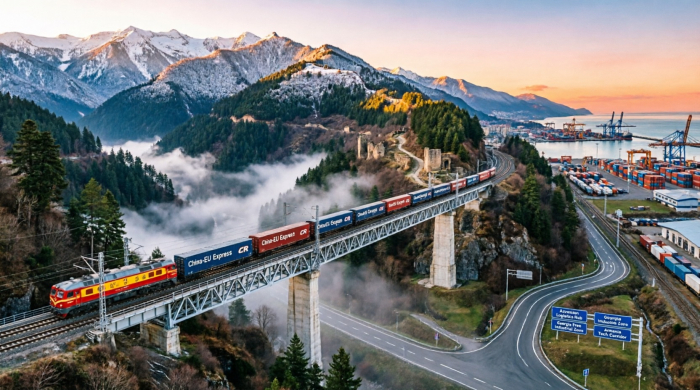
If today one finds oneself at the Port of Alat or at a railway station in Georgia, it is impossible not to notice that the South Caucasus has stopped being just a line in logistics reports. This is a place where reality is changing before our eyes, and this is no longer a forecast of analysts, but a fact that can be seen in the number of containers, in construction contracts, and in the dense schedule of diplomatic visits. Not long ago, the region was perceived as a periphery through which cargo could simply pass, but now the numbers show the opposite. Cargo flow along the Middle Corridor from China has grown more than 25 times in just one year, and trade turnover between China and Azerbaijan is already approaching 5 billion dollars. This is not just statistics, but a signal that a new architecture of Eurasian trade is forming in the region. And in this junction not only railways intersect. China’s Belt and Road with its speed and scale meets Western initiatives like Global Gateway, where standards and transparency are at the forefront. On paper these approaches seem incompatible, like two different languages, but in ports and customs terminals their representatives have to reach agreements every day. The interests of Central Asia, India, Iran, the Persian Gulf countries and Turkey are also involved, and the map has become more complex than a simple binary confrontation. As a result, the South Caucasus is becoming a unique platform where global competition is tested not by declarations, but by how effectively different systems are able to work side by side, turning geoeconomic tension into a driver of development for all participants.
On one side there is China’s Belt and Road initiative, which lives by the rules of speed, scale and pragmatism, which works by the logic decided, financed, built. On the other side there are Western initiatives and programs such as the European Union’s Global Gateway and the American Partnership for Global Infrastructure and Investment, which offer a different path, which bring first standards, transparency and institutional frameworks, and only then concrete and railways. At first glance these are two different realities that can hardly reach agreement. But if we look more closely at the geoeconomic map of the South Caucasus, it becomes clear that reducing everything to a binary confrontation between China and the West means missing half of the picture. At the same time North South corridors are developing, where Russia, Iran and India actively work together, the ambitious IMEC project has been announced, which is supposed to connect India with Europe through the Middle East, and the Persian Gulf countries quietly but steadily invest in port infrastructure of the region. Turkey is also promoting integration initiatives within the Organization of Turkic States. Special attention should be given to the TRIPP project, which in fact creates an alternative to corridor logic, proposing integration of the countries of the region, including Armenia, into transport networks without loss of sovereign control and without extraterritorial mechanisms.
At the level of declarations and strategic documents all of this may look like a knot of incompatible approaches. But it is enough to go down to the ground, to ports, railway stations and offices of logistics companies, and the picture changes. Here Chinese containers move along routes that are partially financed by European development banks. Turkish contractors build hubs that will serve cargo from India. Saudi investment funds take part in projects where technologies and equipment are supplied by Chinese companies. Armenian logistics specialists study TRIPP opportunities while at the same time working with the EAEU and Western partners.
It is exactly this everyday pragmatic coexistence, not loud geopolitical confrontation, that defines the current dynamics of the region. The South Caucasus has become a complex multidimensional system where success is measured not by which model wins in an abstract competition, but by how effectively different players are able to find points of contact in specific projects, where compromise is born not in negotiation rooms, but at the intersection of containers, standards and financial flows. And where the future depends not on ideological purity of approaches, but on the ability to turn geoeconomic tension into a resource of development for all who are ready to work at this crossroads.
What stands behind this shift? First of all the change of the global logistics map. If five years ago goods from China to Europe mainly moved through Russia or by sea, today the situation has changed. For China the Caucasus has stopped being just a transit route and Beijing is interested in stability of the corridor, and stability is impossible without economic development of the countries of the region themselves. And here lies the first point of advantage, because by solving its task of securing supply chains China inevitably invests and will continue to invest in infrastructure of Azerbaijan, Georgia and Armenia. The difference in approaches can be seen on the ground. The Chinese model often wins in time, because decisions are made quickly, financing is allocated for specific projects, and bureaucratic barriers are reduced through intergovernmental agreements. For the countries of the Caucasus that need rapid modernization this is an attractive option. Western initiatives focus on long term institutional compatibility and face requirements related to environmental standards, procurement transparency and legal regulation, which may slow down the start of projects, but make integration into European markets easier in the future. It is important to avoid a simplified view that this is a battle of titans where someone must win. For Tbilisi, Baku and Yerevan such competition is an opportunity to maneuver, where it is beneficial to use Chinese investments to build the economic foundation, while at the same time implementing Western governance standards to attract high quality capital.
Therefore the region faces a key question how to turn this competition into development. And the answer lies in concrete mechanisms, not in declarations of friendship. For example one of the concerns of Chinese logistics operators is fragmentation of customs systems. The introduction of a single digital platform for all corridor countries could reduce cargo delays at borders by up to 40 percent, which is beneficial for everyone, China gains speed, the Caucasus gains transit revenues and the status of a reliable partner. Taking into account the EU climate agenda, creation of green logistics hubs in Georgia and Azerbaijan using Chinese technologies would allow the region to export not only goods but also carbon units. These are a kind of environmental bonuses, when a country or company reduces emissions, for example through solar panels or electric vehicles, it receives a certificate that can be sold to those who need to compensate their carbon footprint. For the South Caucasus this is a chance to turn green investments into additional income, and by modernizing logistics the region not only improves infrastructure, but also earns from making transit cleaner. And projects where Chinese capital is combined with Western insurance instruments can reduce risks for all participants, turning geopolitical competition into financial synergy.
A look into the future of the South Caucasus requires a scenario approach. In an optimistic scenario the region becomes a universal hub where Chinese goods pass European certification, China reduces logistical risks and the countries of the Caucasus gain diversified economies. In a risk scenario political instability or conflict of standards may lead to fragmentation of the route. In this case China will be forced to look for alternative routes and the region risks losing investment attractiveness and strategic importance. That is why pragmatic dialogue becomes more important than ideological preferences. Today the South Caucasus is no longer just a map for laying routes, but a testing ground where it is checked whether different economic systems can coexist in one space and work for a common result. And how effectively it will be possible to combine Chinese efficiency with Western standards will determine not only the future of the region, but also the stability of the entire Eurasian logistics.
In the end the question is not which model wins, but how to get maximum benefit from their interaction. For the countries of the South Caucasus this is a historic chance where there is no need to choose between East and West, but there is a need to learn how to work with both, taking advantages from competition and finding points of contact in real projects. For China this is an opportunity to show that its approach can adapt to complex regional contexts, and for the West to test how its standards can be implemented under conditions of limited time and resources. And if this experiment succeeds the South Caucasus can become an example of how geoeconomic competition guided by pragmatism and diplomacy turns into a driver of development for all participants.
Elbrus Mamedov

