
 Home
HomeChina and Georgia Sign Updated Protocol to the Free Trade Agreement
-
 01 May 2026 11:55
-
 510
510
Latest Interpretation by the Ministry of Commerce
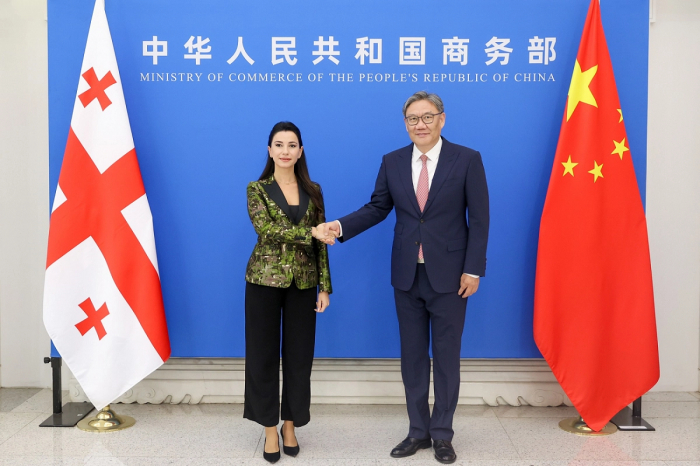
On April 22 in Beijing, Minister of Commerce Wang Wentao and Georgia’s Minister of Economy and Sustainable Development Mariam Kvrivishvili signed a protocol to the revised protocol of the Free Trade Agreement between China and Georgia. A representative of the World Trade Organization Department of the Ministry of Commerce presented an interpretation of the protocol.
I. Significance of the Protocol
The Free Trade Agreement between China and Georgia is the first free trade agreement initiated and concluded by China after the launch of the “Belt and Road” Initiative, and also the first free trade agreement between China and a Eurasian country, which has laid a solid institutional foundation and provided a strong impetus to bilateral economic and trade cooperation. According to Chinese statistics, in 2025 bilateral trade between China and Georgia reached USD 2.699 billion, which is approximately 175.41% higher compared to the level prior to the entry into force of the agreement in 2017. High-quality Georgian agricultural and food products such as wine, coffee, and mineral water are rapidly entering the Chinese market, while Chinese electronic products and digital services enjoy wide popularity among Georgian consumers.
The updated agreement reflects the traditional friendship and political mutual trust between China and Georgia, and also represents a pragmatic step by both countries toward achieving genuine multilateralism and combating protectionism. The agreement is a practical result of implementing the important consensus reached by the leaders of the two countries on deepening the strategic partnership between China and Georgia, and an important measure for implementing the spirit of the Fourth Plenary Session of the 20th Central Committee of the Communist Party of China regarding high-level opening-up. This will create new space for future cooperation between China and Georgia, promote the expansion of bilateral trade and investment, enhance cooperation between enterprises of the two countries, and create a more transparent and convenient business environment. For China, investments in Georgia will become safer and more convenient, while opportunities for cooperation in such areas as the digital economy, new energy sources, and infrastructure will be expanded. For Georgia, exports of high-quality agricultural products to China will be facilitated, and costs will be reduced, which will further accelerate exports to China.
II. General Information on the Protocol
China and Georgia began negotiations on a free trade agreement in December 2015, signed the agreement in May 2017, and it officially entered into force in January 2018. After thorough research and detailed consultations, both sides began negotiations on the extension of the agreement in July 2025. After two rounds of negotiations, the content of the agreement in such areas as sanitary and phytosanitary measures (SPS), technical barriers to trade (TBT), investment, and e-commerce was expanded and improved. In November 2025, in the presence of Premier Li Keqiang and Prime Minister Irakli Kobakhidze, Minister Wang Wentao and Minister Mariam Kvrivishvili signed in Shanghai a Memorandum of Understanding on the results of the negotiations on the extension of the Agreement and agreed to sign the Protocol as soon as possible.
III. Main Content of the Protocol
Based on the original text of the Agreement, this extension mainly includes the updating of chapters on sanitary, phytosanitary, and customs issues, as well as the addition of two new chapters on investment and e-commerce.
(I) Chapter on Sanitary, Phytosanitary and Customs Issues
The revised chapter on sanitary, phytosanitary, and customs issues establishes higher requirements for the transparency of relevant laws and regulations in both countries and creates a consultation mechanism that facilitates timely exchange of information between the two sides, effectively resolves technical issues in bilateral trade in agricultural and food products, and effectively reduces unnecessary inspection and quarantine costs. First, new provisions on technical consultations and subcommittees on sanitary issues have been added, clarifying the process of technical consultations, the composition and functions of the subcommittee on sanitary, phytosanitary, and customs issues, etc.; second, provisions and rules concerning equivalence, transparency, and technical cooperation have been further clarified, including requirements for consultations and provision of information, obligations to report violations of transparency, and information exchange within the framework of technical cooperation; third, specific authorities responsible for contact points have been identified, and an obligation to report changes in contact point information has been added.
(II) Chapter on Technical Barriers to Trade
The revised chapter on technical barriers to trade maintains the original rules and framework of the Agreement, while supplementing and improving certain provisions to enhance practical applicability. It promotes improved coordination and mutual recognition of standards, technical regulations, and conformity assessment procedures between the two sides, reduces unnecessary technical barriers to trade, and effectively facilitates trade development. First, it adds compliance obligations for local authorities; second, it introduces mutual recognition mechanisms such as international multilateral agreements and agreements between conformity assessment bodies, clarifying that both sides may conclude mutual recognition agreements; third, it establishes an obligation to provide, under certain circumstances, summaries of relevant technical regulations and conformity assessment procedures in English; fourth, it clarifies a 60-day period for initiating technical consultations; and fifth, it promotes bilateral cooperation between standardization bodies.
(III) Investment
This new chapter consists of nine articles covering approval procedures, investment promotion, and general principles. Enhancing the transparency of investment approval processes and related information, standardizing relevant procedures, and reducing hidden barriers and uncertainties are aimed at creating a stable, fair, and predictable institutional environment for investors of both sides, as well as further encouraging and facilitating bilateral direct investment. In particular: 1) it clarifies that the parties may encourage each other’s investments in accordance with their foreign investment policies and expand information exchange; 2) it requires public disclosure of relevant investment rules, international agreements, and approving authorities; 3) it stipulates that investment approval procedures must be objective and transparent; and 4) it confirms the validity of the 1993 China–Georgia bilateral investment agreement.
(IV) E-Commerce
The new chapter includes 17 articles covering definitions, general provisions, customs duties, and the framework for internal electronic transactions. It comprehensively establishes a system of rules for e-commerce, effectively promotes the development of cross-border e-commerce, regulates data flows, and provides a stable institutional guarantee for bilateral cooperation in the field of e-commerce. In particular: 1) the Protocol defines relevant terms and the scope of application of the rules; 2) both sides temporarily exempt electronic transmissions from customs duties, create a legal framework for e-commerce in accordance with international norms, recognize the legal validity of electronic signatures, and promote electronic authentication; 3) strengthen online consumer protection, personal data protection, and regulate commercial electronic information; 4) clarify supervision requirements and standards for electronic payments; 5) both sides strengthen exchanges and cooperation in such areas as the financial technology industry.
IV. Entry into Force and Implementation of the Protocol
After the signing of the Protocol, both sides shall duly complete their respective internal approval procedures in order to facilitate the earliest possible entry into force and implementation of the Protocol. We will promptly publish the signed text of the Protocol on the website of the China Free Trade Zone Service (http://fta.mofcom.gov.cn) for public access.
This publication is taken from the official Facebook page of the Embassy of China in Georgia:
https://www.facebook.com/share/p/1BPybpTpZr/

