
 Home
HomeVietnam and Azerbaijan. How a new axis of cooperation between Southeast Asia and the South Caucasus is taking shape
-
 19 Apr 2026 20:37
-
 399
399
Vietnam today is one of the most prominent players in the rapidly changing architecture of Southeast Asia. Its economic surge has long ceased to be a local phenomenon, and the country is increasingly confidently taking its place as a driver of regional integration within ASEAN. The organization, established in 1967, has in half a century evolved from a compact economic alliance into a full-fledged political and diplomatic mechanism. Today, ten states of the region are united not only by common trade flows, but also by a complex system of foreign policy coordination, where the ability to balance national interests and collective goals becomes the main condition for sustainable development.
The ASEAN market, exceeding 600 million consumers, has long placed the bloc among the key centers of global economic growth. And Vietnam in this system is not just a beneficiary, but an active participant that strengthens the regional agenda through its ambitious projects and domestic reforms. At a time when geopolitical axes are shifting and supply chains are being restructured, ASEAN’s ability to speak with one voice and offer stable rules of the game makes it an independent actor in the global economy. Vietnam’s role in this process will only grow, as the country is already setting the tone in the dialogue on what Southeast Asia will look like in the coming decades.
Hanoi has not simply opened its doors to foreign capital, but has organically integrated into global supply chains, turning its advantageous location, the growing qualifications of its workforce, and a stable macroeconomic policy into its main strategic asset. An extensive network of trade agreements has connected the country with the world’s largest economies, removing barriers for the export of high-tech and manufactured goods. Today, Vietnam acts as a predictable and flexible partner, and investors in Vietnam receive not just land for factories, but a living ecosystem where modernized infrastructure, clear rules of the game, and a focus on international standards function as a single mechanism. Each new project or logistics hub stimulates domestic growth and at the same time reinforces Hanoi’s role as an adaptive integrator of global trade, confidently operating even under changing global rules.
In this context, the gradual expansion of Vietnam’s foreign economic and investment interests beyond the traditional Asian space toward the South Caucasus appears both natural and logical, where Azerbaijan objectively acts as one of the key points of attraction. For Hanoi, Baku is not just a new sales market, but a strategic transport and logistics hub capable of opening alternative corridors to Europe and the post-Soviet space, bypassing traditional but increasingly overloaded or politically vulnerable routes. In a world where global supply chains require flexibility and backup options, Azerbaijan’s ability to connect East and West through developed infrastructure, from Caspian ports to railway arteries, makes it a valuable partner for Vietnamese exports and transit.
At the same time, the interest is mutual. Baku sees Vietnam not merely as a distant Asian country, but as a promising and strategically important partner. Through Hanoi, Azerbaijani companies gain access to ASEAN markets with their 600 million consumer potential, as well as to well-established mechanisms of regional integration that Vietnam helps adapt for external partners. Such interaction goes beyond bilateral trade and forms the basis for a more complex, multipolar economic geometry, where the South Caucasus and Southeast Asia begin to speak the same language of logistics, investment, and mutual trust.
The mutual strategic interest between Vietnam and Azerbaijan dates back to the Soviet era, when in the 1950s–1970s the Azerbaijan SSR helped Vietnam restore its economy and build its industrial framework. Baku hosted thousands of Vietnamese students and engineers who mastered advanced technologies in oil extraction and processing at the Azerbaijan Institute of Oil and Chemistry, one of the flagships of Soviet education. These people later laid the first layer of trust between the two countries. The visit of Ho Chi Minh to Baku in 1959 transformed an abstract friendship of peoples into a concrete exchange of knowledge and technologies, reinforcing the recognition of Azerbaijan as an oil center ready to share its experience. A special role in the development of these ties is commonly associated with the figure of the National Leader of the Azerbaijani people, Heydar Aliyev, who during the Soviet period paid attention to strengthening contacts with Vietnam. It was with his participation that Baku built a sustainable system of knowledge exchange rather than a one-time transfer of technologies. Even after the collapse of the USSR, when many ties were broken, Hanoi and Baku maintained a communication channel and confirmed diplomatic relations in 1992. Where others started from scratch, the two countries ensured continuity, relying on a shared history.
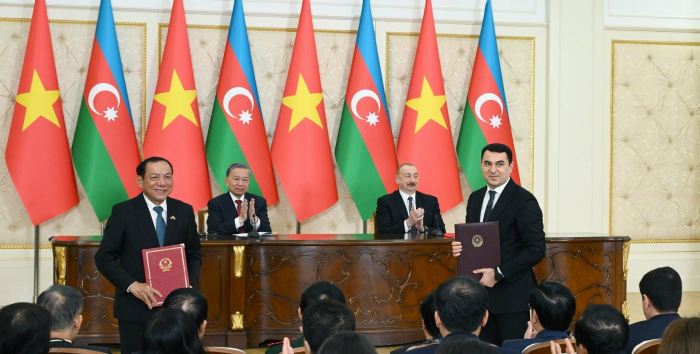
The real revival of the partnership came in the second decade of the 21st century, when historical capital acquired a practical dimension. The visit of President Ilham Aliyev to Vietnam in 2014 and the return visit of Truong Tan Sang to Baku in 2015 became significant milestones in the activation of bilateral dialogue, facilitating its transition from a declarative level to more substantive and systematic interaction. The Intergovernmental Commission on trade, economic, and scientific-technical cooperation launched at that time assumed the role of a permanent coordination mechanism capable of translating strategic intentions into concrete projects, monitoring their implementation, and promptly removing barriers. The years 2025–2026 became a point of qualitative transition for the Vietnam–Azerbaijan dialogue, when relations acquired the features of a mature systemic partnership. The parties moved from isolated initiatives to a comprehensive agenda of interaction in energy, transport, trade, and the humanitarian sphere. In this configuration, Azerbaijan has consolidated its position as Vietnam’s key gateway to the South Caucasus, while for Baku the Vietnamese direction has evolved from an element of diversification into a strategic gateway to the dynamic economy of Southeast Asia.
The most visible evidence of this was the cooperation plan for 2025–2027, approved by the Intergovernmental Commission. The document includes 58 specific measures across 17 priority areas, ranging from joint energy projects and logistics corridors to educational exchanges and the digitalization of customs procedures. It is a roadmap in which each item has an executor, deadlines, and measurable results.
Energy within this roadmap becomes the central element of interaction, where Azerbaijan’s competencies and Vietnam’s growing demand naturally converge. For Hanoi, Baku is not just a supplier, but a partner with experience in global trade, ensuring stable oil supplies through SOCAR, including direct supply to refineries. This strengthens Vietnam’s energy resilience and at the same time reinforces Azerbaijan’s position in one of the most dynamic markets in Asia. At the same time, cooperation goes beyond hydrocarbons. Interaction with ROX Group in the field of renewable energy forms the basis for joint projects in solar and wind power, energy storage, as well as in the areas of green hydrogen and ammonia. As a result, energy cooperation is transitioning from a raw-material exchange to a comprehensive model that includes technology transfer, human capital development, and integration into modern production chains.
Against this background, the economic agenda is taking on tangible forms. Trade turnover for the first eleven months of 2025 reached 141.8 million dollars, and although the figure is modest, the steady dynamics indicate that business perceives the dialogue as a working opportunity. Negotiations with VinFast on the possible assembly of electric vehicles for the South Caucasus signal a readiness to move beyond the classical export-import model. The textile industry is developing along a similar logic, and joint production of cotton products предполагает deep integration from raw materials to the export of finished goods to third markets. Today, Baku is creating tax preferences, access to industrial parks, and simplified administrative procedures that lower the entry threshold and accelerate project launches. For Vietnamese companies that have accumulated experience in rapid scaling, such proposals are particularly attractive. Azerbaijan, in turn, is interested in economic partners capable of bringing management practices, technologies, and access to Asian markets. The investment dialogue is evolving into an instrument of mutual transformation, where Baku accelerates its transition to a non-resource economy, and Hanoi gains footholds for global expansion.
The development of industrial cooperation is impossible without a reliable transport foundation. Vietnam is exploring the potential of Trans-Caspian routes and the Middle Corridor, which reduce delivery times and lower dependence on congested maritime routes. In this configuration, Azerbaijan becomes for Hanoi a strategic transit hub connecting Vietnamese production capacities with the markets of the CIS, Europe, and Eurasia. The benefits are systemic: Vietnam gains acceleration of export flows and predictability of supply, while Azerbaijan receives an incentive to modernize ports and customs procedures. If these plans are implemented, cooperation may become an element of an emerging Eurasian logistics contour. Transport integration is not limited to land and sea corridors. The expansion of Silk Way Airlines’ presence in the Asian direction, as well as discussions on launching direct cargo routes, create prerequisites for moving to a more practical stage of interaction, where logistics issues acquire applied significance. Even more significant in the long term is the potential launch of a passenger route Baku–Hanoi. Direct air communication will create an infrastructural basis for accelerating all forms of interaction, while business contacts will cease to depend on connections, tourism will receive a predictable channel, and humanitarian exchanges will gain rhythm. The humanitarian dimension gives economic rapprochement social sustainability. The resumption of specialist training programs, the promotion of agreements in the field of education, cultural projects, and initiatives such as the Days of Vietnam in Azerbaijan create a soft infrastructure of trust. It is at the level of human contacts and cultural empathy that a reserve of resilience is formed, allowing the partnership to withstand external fluctuations.
In the regional dimension, Azerbaijan is viewed by Vietnam as one of the key directions for developing interaction in the South Caucasus, while cooperation with Georgia and Armenia is also consistently developing within separate bilateral formats. Azerbaijan offers a comprehensive model where energy, logistics, investment, and political coordination function as a single mechanism. As a result, a new point of convergence is being formed between Southeast Asia and the South Caucasus, where Baku acts as a platform for access to Eurasian markets, and Hanoi as a technological partner with access to the dynamics of ASEAN. Thus, interaction goes beyond the bilateral agenda and acquires the format of a structural geoeconomic partnership. This creates conditions for the gradual integration of the two regions into a single logistics and production chain, minimizing dependence on intermediaries.
Elbrus Mamedov

