
 Home
HomeThe South Caucasus at a Crossroads: Will the Region Become a New “Switzerland” or Choose Its Own Path?
-
 27 Mar 2026 18:48
-
 362
362
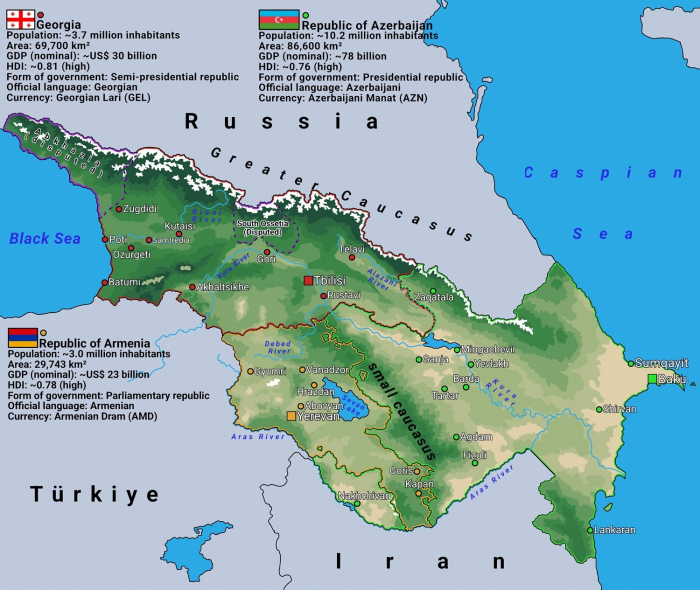
Geopolitical clouds are once again gathering over the Caucasus, and the region that some idealists once imagined as a new Switzerland has, in reality, found itself at the epicenter of an increasingly complex great-power game. If we look at this land not through the привычная lens of borders, but through the logic of global transformation, a deeper question emerges—one that goes far beyond first impressions. Can a territory long perceived as a zone of instability transform into a space of sustainable balance? And is it possible to preserve such a balance under the pressure of major global actors?
This is not about mechanically copying the Swiss model of neutrality. It is about searching for a unique path between competing centers of power, where geography is no longer just a given, but a strategic asset. Trade routes that were once considered secondary now run through the South Caucasus, increasingly becoming vital arteries of global commerce. The Middle Corridor is no longer a backup option—it is a fully fledged bridge between China and Europe. In this new reality, the countries of the region have a rare opportunity not only to service flows, but to shape the rules of the game and define their own future. The transformation of the region from a buffer zone into a connective link between East and West could fundamentally alter the nature of risk, making stability beneficial for all participants. Yet at the same time, the value of choice is rising, because the Caucasus is not a vacuum where one can act in isolation.
The interests of multiple global players intersect here, and the Swiss model of neutrality, attractive as it may seem at first glance, remains more of a beautiful utopia than an achievable reality for the Caucasus. Switzerland built its neutrality over centuries, relying on geographic protection, economic self-sufficiency, and internal unity. The Caucasus exists in entirely different conditions—at the crossroads of civilizations.
Internal differences further complicate matters. Georgia has traditionally pursued Euro-Atlantic integration. Armenia is actively seeking new formats of international cooperation following its defeat in the Second Karabakh War. Azerbaijan continues to pursue a consistent multi-vector policy. These differing strategic orientations, combined with unresolved issues and national priorities, make the formation of a classical neutrality model difficult. At the same time, they highlight the need for more flexible and pragmatic forms of cooperation.
External pressure on the South Caucasus is undeniably strong and often appears inevitable, pushing the region back into turbulence. The European Union brings its regulatory framework and institutional logic. Russia maintains its strategic priorities. The United States views the region as part of a broader security architecture—an approach that does not always lead to stability. Each of these actors offers not only investment, but also its own vision of how the future world should be structured.
This raises a defining question of our time: is it possible to accept resources without accepting someone else’s rules? Can the region become an open platform for cooperation without turning into a battleground for great-power competition?
The reality is that the Caucasus is unlikely to become a zone of calm neutrality in the near future. The interests of external actors are too significant, and internal contradictions remain too deep. Yet this does not mean the region is destined to remain a permanent zone of risk and instability. On the contrary, a window of opportunity is opening—one where economic pragmatism may begin to outweigh military confrontation. A version of a “new Switzerland” is not impossible, but it would require precise and wise calibration of all mechanisms of interaction. This includes transparent rules for all partners and strong national institutions capable of withstanding external pressure while preserving sovereignty. Coordinated regional policies—at least in key areas such as logistics, tariffs, and investment—are essential. Most importantly, the region must move away from short-term gains toward long-term stability.
An alternative, more fragmented scenario—often associated with a purely pro-Western trajectory—carries its own risks. In such a case, competition between external actors intensifies, rules begin to contradict one another, infrastructure develops unevenly, and the region gradually fragments. The Caucasus then ceases to be a unified bridge between civilizations and instead becomes a collection of disconnected segments with differing speeds and interests. In this scenario, it is not the countries of the region that benefit, but external actors skilled at exploiting divisions.
The year 2026 will likely prove decisive. Political processes in Armenia, internal dynamics in Georgia, the development of the TRIPP transport corridor, and the broader situation in the Middle East will all shape the region’s trajectory. In this context, the Chinese vector acquires particular depth and significance. Beijing does not seek dominance in the Caucasus in a traditional imperial sense. China comes not with military bases or ultimatums, but with investment, large-scale infrastructure projects, and long-term strategic vision. The Belt and Road Initiative offers the region a unique opportunity to become a true living bridge between dynamic Asia and prosperous Europe, connecting civilizations through dialogue and mutual benefit.
Chinese investment in Georgian infrastructure and interest in transport corridors through Azerbaijan and Armenia go far beyond simple economics. They represent a historic opportunity for the countries of the Caucasus to diversify international ties, reduce dependence on traditional actors, and gain greater freedom in shaping their own future. China offers a model of partnership based on respect for sovereignty and non-interference in internal affairs—an approach that resonates strongly with the aspirations of the region’s nations. Its philosophy of long-term planning encourages thinking in decades rather than election cycles, which is especially valuable for a region weary of recurring instability.
In this sense, cooperation with China becomes not merely an economic choice, but a strategic opportunity to build a future in which the Caucasus is not an object of external interests, but a subject of its own destiny. Today, the peoples of the Caucasus have a truly historic opportunity to define their own path of development—one grounded in pragmatic wisdom, expanded economic cooperation, and deep mutual respect for sovereignty. This is not just rhetoric, but a real chance to determine the region’s place in a changing world.
The key task for the countries of the South Caucasus is to strengthen their role as independent and responsible actors in international affairs. This means not only responding to external challenges, but shaping their own development agenda, setting the terms of cooperation, and engaging as equal partners with major powers. The South Caucasus today is a space of historic choice. A choice between being merely a transit corridor or becoming an independent center of development. A choice between dependence on external decisions and the pursuit of a balanced, self-defined path. A choice between fast but superficial investments and a long-term strategy that lays the foundation for prosperity.
Ultimately, the future of the region depends on this choice. Will the Caucasus become a bridge connecting civilizations, or remain an arena for external interests? Perhaps the real question is not whether the South Caucasus will become a new Switzerland by copying someone else’s model, but whether it can develop its own unique framework—where neutrality is not a declaration on paper, but a real instrument of strength and independence. Engaging new partners from Asia offers the countries of the region not the role of pawns in someone else’s game, but that of full owners of their own transit potential. This path requires careful decisions, institutional resilience, and broad public support—but it is entirely realistic with consistent and well-thought-out policy.
Elbrus Mamedov

