
 Home
HomeChina and Georgia Strengthen Mutually Beneficial Partnership in a New Economic Reality
-
 27 Apr 2026 11:25
-
 431
431
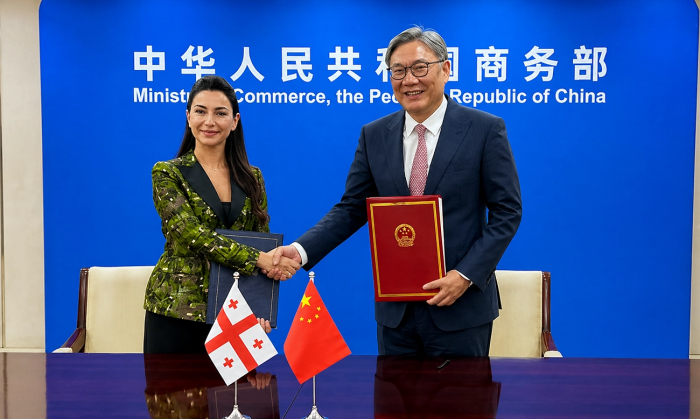
A meeting was held in Beijing between Georgia’s Minister of Economy and Sustainable Development Mariam Kvrivishvili and the Minister of Commerce of the People’s Republic of China Wang Wentao, during which the parties discussed strengthening economic cooperation and the prospects for increasing exports of Georgian products to the Chinese market. The negotiations confirmed the steady development of bilateral relations and the parties’ intention to further deepen cooperation. The focus was on both the current trade ties between Georgia and China, as well as new opportunities to expand cooperation, including investment collaboration and the entry of Georgian producers into one of the world’s largest markets.
One of the key outcomes of the meeting was the signing of a protocol on the implementation of amendments to the Free Trade Agreement between the two countries. The updated document provides for adapting the agreement to modern conditions of international trade, clarifying existing areas of cooperation, and including new sectors such as e-commerce and investment.
As noted by Mariam Kvrivishvili, the introduced changes represent a strategically important step toward deepening economic partnership and are expected to contribute to further growth in bilateral trade turnover. According to her, the intensification of economic relations in recent years has been driven both by active high-level political dialogue and by the expansion of cooperation between the business sectors of the two countries. Particular attention during the meeting was paid to expanding access for Georgian products to the Chinese market. Within the framework of the Free Trade Agreement, work continues on granting access to Georgian livestock products, including poultry meat and Georgian honey, which opens additional opportunities for exporters.
Statistical indicators confirm the effectiveness of the partnership being developed. After the Free Trade Agreement entered into force on January 1, 2018, exports from Georgia to China reached USD 327.6 million in 2025, increasing by 62% compared to 2017. The total trade turnover between the countries grew by 148% in 2025 relative to the baseline period, and in the first quarter of 2026 increased by another 55%. At present, China ranks third among Georgia’s trading partners and is the largest destination for Georgian exports.
During the negotiations, the parties also discussed mechanisms for promoting Georgian products on the Chinese market, including the implementation of a special program to enhance their competitiveness. Additionally, issues related to attracting Chinese investment were considered, primarily in the transport and logistics sector, infrastructure, and energy, including projects in gas and oil extraction.
The development of tourism cooperation was also a separate topic. It was noted that in the first quarter of 2026, the number of visitors from China increased by 49%, facilitated by the launch of direct flights and the introduction of a visa-free regime effective from May 28, 2024. Currently, up to ten flights per week operate between the countries, significantly strengthening transport connectivity and people-to-people ties.
The foundation of this partnership is the Free Trade Agreement, in force since 2018 and now being updated by a protocol that takes into account the realities of the digital economy, e-commerce, and investment cooperation. The strategic nature of the relationship was officially established in July 2023, and an important step toward people-to-people engagement was the introduction of a visa-free regime: Chinese citizens have been able to visit Georgia without a visa since September 2023, and Georgian citizens have been able to visit China since May 2024, which has already produced results. Tourist flow from the PRC increased by 49% in the first quarter of 2026.
Chinese investments in Georgia, although still lagging behind in volume compared to European or American investments, demonstrate steady positive dynamics and focus on strategically important sectors. Chinese companies have already implemented projects in the construction of hydroelectric power plants and industrial parks, and are participating in the modernization of the road network and port infrastructure, including the promising project of the deep-sea port of Anaklia. Particular attention is paid to logistics, as Georgia is a key link in the “Middle Corridor” connecting China with Europe through Central Asia and the Caspian, and the railway route “Tianma” (Wuwei–Tbilisi) has already been launched, confirming the practical value of this direction. The “Tianma” railway route is an international freight route launched in February 2022 to develop trade and economic relations between China and Georgia. It connects the South Station of Wuwei (Gansu Province) with Tbilisi, ensuring transit through Central Asia.
At the same time, cooperation in the field of digital technologies is developing, and the parties are discussing the creation of a transregional digital hub, as well as the exchange of expertise in telecommunications and information systems. For Georgian businesses, this opens access to Chinese technologies and platforms, while for Chinese companies it creates the opportunity to use Georgia as a testing ground for entering the markets of the South Caucasus and Eastern Europe.
The pragmatic foundation of the partnership and mutual benefit without ideological burden allow the parties to move forward effectively. China gains a reliable transit partner with access to the Black Sea and a liberal investment climate. Georgia gains access to capital, technologies, and the world’s largest consumer market, as well as strengthening its role as a regional logistics and trade center.
If current trends continue, Georgian-Chinese cooperation may become a benchmark example of how a small country with strong transit potential and a global economic power can build long-term, mutually beneficial interaction.
Gulnara Safarli

