
 Home
HomeTurkmenistan and Georgia in the architecture of Eurasian logistics
-
 26 Feb 2026 17:00
-
 388
388

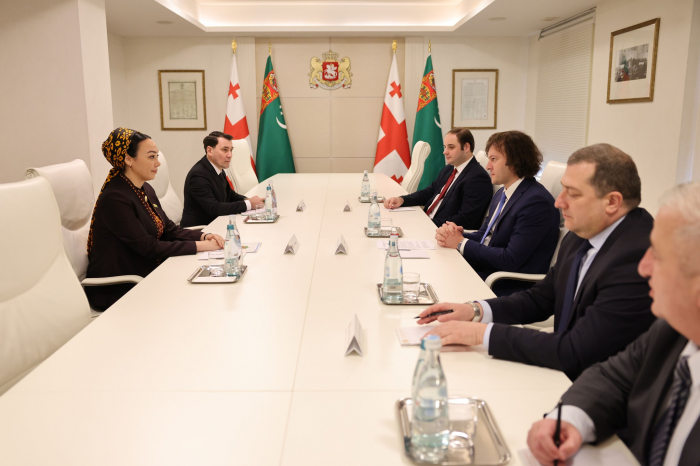
Prime Minister of Georgia Irakli Kobakhidze received the Speaker of the Mejlis of Turkmenistan, Dunyagozel Gulmanova, at the Government Administration. The nature of the meeting was originally designated as a working meeting. However, the ambience of the meeting suggested an alternative interpretation. It appeared to be a dialogue between partners who acknowledged the necessity of maintaining constant attention and active dialogue regarding the relations between their respective nations. During the discussion, the parties noted that political and economic contacts between Tbilisi and Ashgabat are being consistently developed, and they emphasized the positive dynamics in trade relations. A particular emphasis was placed on transit, logistics, and energy, as these domains are progressively emerging as the cornerstones of regional interaction. Georgia and Turkmenistan have already established a collaborative relationship in these domains, and the dialogue revealed that both parties are interested in enhancing their cooperation, particularly in the context of developing the Middle Corridor. This route is gradually gaining strategic importance by connecting Central Asia with Europe through the South Caucasus. The meeting was also attended by the Head of the Government Administration, Levan Zhorzholiani; the Ambassador of Turkmenistan to Georgia Dovletmyrat Seyitmammedov and the Ambassador of Georgia to Turkmenistan, Konstantin Sabiashvili. This triad of diplomats underscored the practical nature of the negotiations and the readiness to translate discussions into concrete steps.
A significant practical step was taken during the visit with the signing of a cooperation agreement between the Parliament of Georgia and the Mejlis of Turkmenistan. This document established the foundation for more systematic and dynamic interaction between the legislative bodies of the two countries. The initiative encompasses the cultivation of relationships among parliamentary friendship groups, profile committees, young parliamentarians, women parliamentarians, and parliamentary administrations. This approach fosters the establishment of a stable network of contacts, thereby facilitating continuous dialogue and the development of tangible relations.
Dunyagozel Gulmanova observed that Georgia occupies a significant position within the framework of Eurasia's strategic transport corridors and conveyed Turkmenistan's willingness to collaborate in the enhancement of transport infrastructure. Her remarks reflected an understanding that the resilience and development of transit routes are important not only for the two countries but also for broader regional stability.
The Turkmen side also reaffirmed its firm support for the sovereignty and territorial integrity of Georgia. Conversely, gratitude was expressed to the Georgian side for their support of Turkmenistan's policy of permanent neutrality. These reciprocal expressions of respect for pivotal national priorities contribute to enhanced resilience in bilateral relations, thereby fostering the establishment of a robust foundation for long-term partnerships.
The region between the Caspian and Black Seas is currently undergoing a reassessment of its role. The traditional supply routes are becoming vulnerable, Europe's energy architecture is undergoing transformation, and Eurasian states are increasingly seeking sustainable formats of cooperation. In the context of contemporary geopolitical dynamics, the South Caucasus and Central Asia are undergoing a gradual transition from a peripheral status, becoming increasingly recognized as a pivotal nexus between East and West.
In this configuration, Georgia is not merely a transit territory. This locale is distinguished by its role as a nexus of converging interests, functioning as a pivotal infrastructure hub. It serves as a conduit for various transportation networks, including railway lines, port routes, energy projects, and digital cables. Turkmenistan, for its part, remains a pivotal energy player in Central Asia, with considerable resource potential and a strategic interest in diversifying export directions. The ongoing dialogue between Georgia and Turkmenistan pertains to the future of roads and routes, with the objective of enhancing the predictability and comprehensibility of future cooperation over an extended period. In essence, the objective is to safeguard the region against external shocks and to enhance its developmental trajectory, ensuring greater resilience and predictability. Such meetings are indicative of a form of quiet diplomacy, wherein not only formal frameworks of cooperation are discussed, but also a shared vision of the future is established. The objective is to establish a novel paradigm of interaction between transit and energy systems, wherein coordination supersedes competition. The various elements of the Middle Corridor, the development of port infrastructure, and the potential energy projects across the Caspian are gradually coalescing into a unified whole.
In the contemporary era, advantageous geographical circumstances alone are no longer adequate. The functionality of a map is contingent upon its integration with meticulously formulated policy, the establishment of trust among neighboring communities, and the demonstration of a propensity to reach consensus. The inherent value of geography is exemplified when it evolves into a dynamic system of interconnections, wherein routes, infrastructure, and partnerships synergize to offer tangible advantages to individuals and economies. Consequently, meetings of this caliber are imbued with a distinctive significance.
Turkmenistan has historically been recognized for its balanced foreign policy, which is predicated on the principles of neutrality and consistency. For an extended period, the nation concentrated on the effective utilization of its substantial energy resources and the establishment of stable export routes. This strategy enabled Ashgabat to maintain predictability even during periods of global economic turbulence.
In recent years, Turkmenistan has adopted a policy of increased international engagement, while maintaining its traditional approach of caution and balance. The nation is currently pursuing the establishment of novel export routes, recognizing that a unidirectional reliance on a single market no longer ensures the same level of confidence. This initiative entails more than a mere alteration in delivery routes; it signifies a comprehensive endeavor to augment opportunities for businesses, producers, and the broader economic landscape. Turkmenistan seeks to cultivate a more extensive network of partnerships and fortify its connections with both Asian and Western markets. This approach is pragmatic in nature, as the proliferation of directions and partners serves to enhance the resilience of foreign trade, thereby reducing its vulnerability to fluctuations in any single region. In essence, the nation is endeavoring to establish a more balanced and dependable system of external economic relations, thereby fostering a greater sense of confidence in the face of rapidly evolving global dynamics. Ashgabat's strategic approach entails the expansion of its economic opportunities, a maneuver designed to navigate a rapidly evolving global landscape characterized by the dynamic development of rules and markets. In this context, Georgia begins to play a special role. It is important to note that the Netherlands has evolved from a mere transit country to a pivotal nexus for transport and energy flows. The region's geographic context establishes a natural connection between the Caspian region and Europe. In this configuration, Turkmenistan functions as a dependable provider of resources, while Georgia serves as a stable conduit through which these resources are channeled to European markets. Such cooperation logically complements each other's capabilities and makes the Eurasian transport system more resilient. The interaction between Georgia and Turkmenistan is an integral component of a comprehensive strategy aimed at enhancing stability and promoting development in the region. Participation in the development of the Middle Corridor provides Turkmenistan with additional opportunities to expand exports and establish more flexible trade routes. Concurrently, the nation maintains its customary balanced and autonomous course, merely incorporating novel prospects into the prevailing array of opportunities.
In the contemporary global economic landscape, it is imperative for nations like Turkmenistan to possess multiple avenues for the exportation of their products. In the contemporary global context, marked by rapid and often unpredictable transformations, the pursuit of a single, overarching direction becomes a precarious endeavor. The presence of a multitude of routes and delivery options has been shown to contribute to a perception of economic stability. In this regard, Georgia emerges as a natural partner. The country's strategic location provides convenient access to the Black Sea and established connections with European transportation networks, thereby facilitating access to Western markets. This issue encompasses not only the Middle Corridor, but also the implementation of pragmatic measures such as the modernization of ports, the streamlining of customs procedures, and the development of efficient logistics networks traversing the Caspian and Caucasus regions.
Turkmenistan possesses some of the world's largest gas reserves, a factor that renders its role in the Eurasian supply system substantial. The European Union's inclination towards cooperative endeavors is a rational response to the necessity of ensuring reliable and diversified energy sources. The Caspian region is gradually becoming part of a unified energy and transport system, in which Turkmenistan occupies an important and responsible place thanks to its resources, geography, and consistent policy.
Ashgabat has expressed interest in the expansion of non-commodity exports, while Tbilisi has indicated a desire to develop re-export operations and generate added value. This initiative presents a range of opportunities for collaboration in various sectors, including agro-processing, the chemical and textile industries, and the production of construction materials. At a more strategic level, it facilitates the establishment of joint enterprises and industrial zones that are oriented towards third markets. The enhancement of the Middle Corridor necessitates not only the development of infrastructure but also the harmonization of financial settlements, insurance mechanisms, logistics platforms, and electronic documentation. In the context of contemporary logistics, the absence of digital integration in any given route invariably leads to a diminution in its competitiveness. The objective is to establish a cohesive, technologically interconnected trade ecosystem.
For Turkmenistan, Georgia is a rational and comprehensible partner along the natural route to the European market. This cooperative endeavor is founded on shared interests in infrastructure, logistics, and energy, with a focus on pragmatic outcomes and a deliberate avoidance of excessive politicization. The ongoing dialogue between Ashgabat and Tbilisi is not influenced by transient factors but rather by the shared long-term objectives and mutual respect for national priorities of both states. This dynamic fosters stability and predictability in the relationship between the two nations.
GSR

