
 Home
HomeThe China–Caucasus–Central Asia Triangle: A Focus on Adaptability, Long-Term Strategy, and Partnership Architecture
-
 01 Jun 2026 20:37
-
 364
364
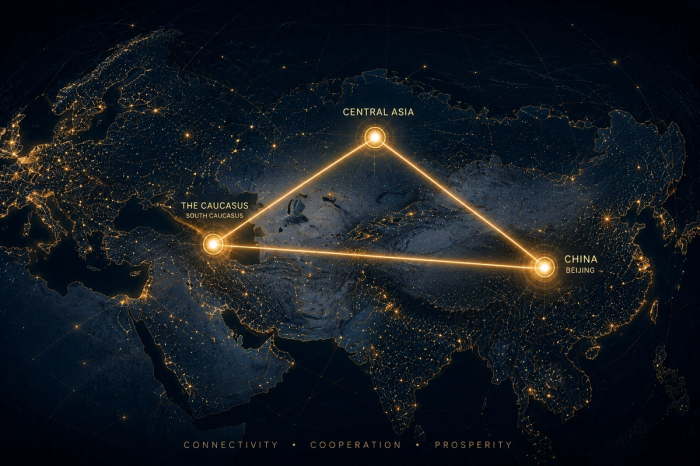
When supply chains break down and corridors close, it is customary to speak of a crisis. But what if what we are witnessing is not a collapse, but a restructuring? Eurasia is not losing connectivity, but changing its architecture — from a model optimized for speed and low costs to a model designed for resilience to disruptions. If a system is configured solely for maximum speed and efficiency, it works like a clock as long as everything is perfect. But once a single link breaks, the entire system stops. The new model, designed for resilience to disruptions, places reliability above records and speed. Routes are designed with backup paths and “safety cushions.” If one section fails, cargo simply changes direction, while the entire network continues operating. Shocks are absorbed locally rather than breaking the system.
During this transformation, the Caucasus, Central Asia, and China have ceased to be passive observers and are now charting their own course through geopolitical storms. The closure of northern routes, pressure on southern directions, and even changes in the level of the Caspian Sea do not destroy the region’s transit potential. On the contrary, these challenges clearly demonstrate that reliability is not ensured solely by speed or rigid centralization. The geopolitics of the Middle Corridor will now rely on backup routes instead of selective cost efficiency, joint risk management instead of external dependence, and regional autonomy instead of the status of a “transit periphery.”
The Caucasus and the Caspian region are increasingly shedding the label of being “just a transit zone.” The region is becoming a key hub upon which the stability of the whole of Eurasia depends. What was previously considered a weakness — being a crossroads of interests, having a volatile climate, and neighboring unstable regions — has now become a practical advantage. A favorable geographic location no longer requires external control. It is managed by the countries of the region themselves, coordinating rules and routes together.
At the same time, China is building a strategy of continental connectivity, abandoning attempts to “repair” old corridors through outdated methods. Instead of short-term tariff optimization, Beijing is investing in long-term resilience, and capital is directed not only toward speed, but also toward redundancy. Alternative routes are being created, while service, warehouse, and production capacities are localized along transport corridors. If one section fails, the chain does not break, and cargo flows are automatically redistributed through neighboring hubs.
By deepening ties with Central Asia and the Caucasus, China adheres to a model of “cooperation without diktat.” Infrastructure projects are accompanied by technology transfer, joint risk monitoring, and the creation of multilateral coordination platforms. Through these platforms, partners coordinate security standards, environmental requirements, and digital logistics protocols. Beijing is not seeking unilateral control over routes. Its role is transforming into that of a network integrator that strengthens the resilience of Eurasian logistics for all participants.
Today, the main driver of these changes for the South Caucasus is the pragmatic neutrality of the countries of the region. While major powers compete for influence, the Caucasus does not side with anyone, but instead becomes a buffer that absorbs geopolitical shocks. Caucasian transit has ceased to be merely a road for moving containers across borders. It is turning into a platform for negotiations and a mechanism for building trust without pressure. Countries jointly agree on tariffs, environmental standards, and security rules, transforming their advantageous location into real political weight. Such neutrality is not detachment, but a clear action plan. It allows routes to remain open even during periods of tension and uses transit as a guarantor of stability for all participants.
This system becomes truly durable when it connects with the networks of Central Asia. The linkage of Caucasian routes with the hubs of Kazakhstan, Uzbekistan, and Turkmenistan creates a reliable “safety zone.” Previously, route duplication was considered wasteful; now it is insurance. If one section fails, cargo is instantly redirected through an alternative route without delays or additional costs. Local repair bases, shared warehouses, and unified border regulations function as shock absorbers that neutralize crises locally. The region no longer passes problems further down the chain; instead, it absorbs the shock, redistributes cargo, and restores the system to working order.
These shifts are clearly visible in the example of the Belt and Road Initiative. If at the beginning the primary goal was to build roads and launch routes as quickly as possible, Beijing is now changing its role. China is no longer simply financing construction projects, but creating a reliable system. Clearly fixed routes are giving way to a flexible network. Digital cargo tracking platforms, modular logistics hubs, unified cybersecurity standards, and joint risk control centers allow the system to instantly adapt to any changes. China is now building not merely “corridors,” but entire ecosystems. Within them, infrastructure, data, and rules operate as a single mechanism that does not collapse under external pressure, but instead restructures itself.
The central element of this new system is becoming the triangle “China – Central Asia – Caucasus.” While the world is fragmenting into blocs, this linkage is creating a foundation of stability in which economic integration develops faster than politics, allowing trade to function predictably. Beijing is not dictating terms to the region, but offering equal partnership — common customs regulations, joint reserves of fuel, fertilizers, and food supplies, as well as digital platforms for real-time cargo tracking. In such a model, crises do not spread through the chain like fire. They are extinguished locally, and if one section experiences pressure, others automatically absorb the additional burden, allowing the entire network to continue operating without disruption.
The success of Eurasian logistics is now measured not in kilometers or delivery speed. The main indicator is the ability of the network to absorb chain crises without collapsing and to quickly adapt. Having gone through route disruptions, climate shifts, and political pressure, the Caucasus, Central Asia, and China stand on the threshold of creating a system in which their strengths mutually reinforce reliability. The region will transform its transit position into genuine autonomy, while Beijing will transform direct corridors into a flexible network of joint risk management. The new model is based on three principles: backup routes are more important than maximum speed, joint adaptation replaces dependence on a single center, and decisions are made locally rather than imposed from above. Digital customs platforms, local service hubs, and cross-border reserves of fuel and fertilizers translate these principles into everyday logistics. When crises emerge, the network does not waste time searching for those responsible, but rapidly redirects cargo flows, activates reserve circuits, and preserves the predictability of supply chains. This is no longer a “winner-takes-all” game, but a system in which the weakness of one link is compensated by the strength of the entire network.
Over the next decade, these principles will become the standard. For the countries of the Caucasus and Central Asia, this means moving from “patching holes” to long-term planning — including green logistics, shared digital hubs, and risk control centers that will become the foundation of national strategy.
Elbrus Mamedov

