
 Home
Home77 Years of the People’s Republic of China: Xi Jinping on a New Stage of China’s Development
-
 03 Oct 2026 15:26
-
 73
73
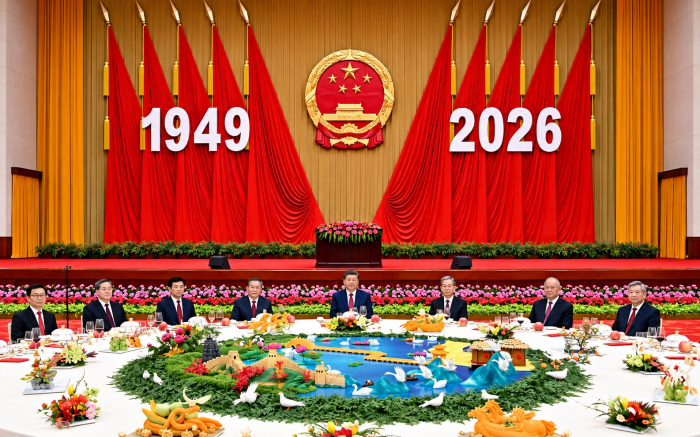
Speaking on September 30 at a reception marking the 77th anniversary of the founding of the People’s Republic of China, Chinese President Xi Jinping offered a broad assessment of the path China has travelled and outlined the main priorities for the country’s future development. The central theme of his address was confidence in China’s ability to continue along its chosen development path despite an increasingly complex domestic and international environment. Xi Jinping began his speech by addressing the people of the country, members of the People’s Liberation Army and the People’s Armed Police Force, representatives of the democratic parties and public figures without party affiliation. He also addressed the people of Hong Kong and Macao, compatriots in Taiwan, and overseas Chinese communities. In addition, he expressed gratitude to foreign countries and international friends who have supported China’s development over the years.
Reflecting on the 77 years since the founding of the People’s Republic of China, Xi Jinping highlighted two major achievements that Beijing sees as defining features of China’s development path, rapid economic growth and long term social stability. In his assessment, under the leadership of the Communist Party of China, Chinese society has travelled an extraordinary historical path, accomplished the goal of building a moderately prosperous society in all respects, and thereby achieved the first of the country’s two long-term development goals.
China, as Xi Jinping’s remarks indicate, is now entering the next stage. Its objective is to build a modern socialist country and further advance Chinese modernization. Xi Jinping acknowledged the considerable pressure and numerous risks China has faced over the course of the year. However, in his assessment, the Chinese economy withstood this pressure, maintained its resilience and continued its structural transformation. Of particular significance is the fact that 2026 became the first year of the implementation of the 15th Five-Year Plan. Thus, Xi was not merely assessing the current economic situation. In effect, he was marking the beginning of another strategic cycle in China’s development. The principal task at this stage, he said, is to maintain stability while continuing to make progress. China should continue implementing its new development philosophy, accelerate the formation of a new development pattern, deepen reform and opening-up, while paying greater attention to the relationship between development and security.
Judging by Xi’s speech, the Chinese leadership no longer views economic growth in isolation from geopolitical and domestic risks. Economic modernization must be accompanied by the state’s ability to withstand external pressure, crises and uncertainty. At the same time, Beijing is not signalling any retreat from openness. On the contrary, Xi called for further deepening reforms and expanding the openness of the Chinese economy while simultaneously strengthening its resilience. Social policy remains another important priority. The Chinese leader set the task of continuing to improve people’s well-being and achieving the key economic and social targets for the current year.
Xi Jinping devoted a separate part of his speech to Hong Kong and Macao. He reaffirmed the continued commitment to the principle of “one country, two systems,” as well as the principles of “Hong Kong administered by Hong Kong people” and “Macao administered by Macao people,” with a high degree of autonomy. At the same time, the Chinese leader stressed the need for deeper integration of these territories into the country’s overall national development strategy.
Beijing is therefore simultaneously reaffirming the special status of Hong Kong and Macao while seeking to integrate them more closely into the economic and political development of the country as a whole.
Xi adopted a considerably firmer tone on the Taiwan issue. He stressed the need to deepen exchanges and cooperation across the Taiwan Strait and promote the peaceful development of cross-Strait relations. At the same time, he once again outlined Beijing’s red lines. According to Xi, China intends to firmly safeguard its national sovereignty and territorial integrity, resolutely oppose any separatist activities aimed at “Taiwan independence,” and resist external interference in the Taiwan question, which Beijing regards as China’s internal affair. He identified advancing the process of national reunification as the ultimate objective of this policy. This demonstrates that, for the Chinese leadership, the Taiwan question remains not merely one area of foreign policy, but part of a broader concept of national rejuvenation and national unity. Xi Jinping linked China’s future international engagement to the advancement of Beijing’s four global initiatives and the concept of a community with a shared future for humanity. China, he said, should bring greater certainty and positive energy to a world that is becoming increasingly unstable and complex.
This formulation is particularly significant. Beijing presents itself not only as one of the world’s major powers defending its own interests, but also as a source of stability within the international system. In effect, China is putting forward its own vision of what the international order should look like amid intensifying geopolitical competition.
Viewed in the broader context of Chinese diplomacy in recent years, this represents an attempt to bring together development, security, inter-civilizational dialogue and global governance within a single foreign-policy framework. In his speech, Xi did not elaborate in detail on each of the four global initiatives. However, mentioning them together indicates that Beijing already regards them as interconnected elements of a broader Chinese international platform. Xi Jinping stated that long-term practice has demonstrated the advantages of the socialist system with Chinese characteristics, while China’s system of governance and governance capacity continue to improve. He once again identified the great rejuvenation of the Chinese nation as the country’s principal historical objective. In his interpretation, this process has already become irreversible.
However, as the Chinese leader emphasized, achieving these objectives requires confidence, consistency and steady progress. The Chinese leadership believes that the country’s strategic direction has been correctly defined, and Beijing does not intend to change it under external pressure. China is not promising the world that it will withdraw from competition, nor is it demonstrating any willingness to abandon its core national interests. Instead, it is proposing a different approach: to sustain development amid competition, preserve stability amid international crises, strengthen its own strategic autonomy, and at the same time seek to prevent rivalry among the world’s major powers from evolving into a system of uncontrolled global confrontation. It is precisely in this context that the central international message of Xi Jinping’s speech should be understood: the need to bring greater certainty to a world marked by profound change and instability.
GSR

