
 Home
HomeThe Transafghan Railway and the Formation of Multivector Connections in Central Asia
-
 04 Oct 2026 13:57
-
 15
15
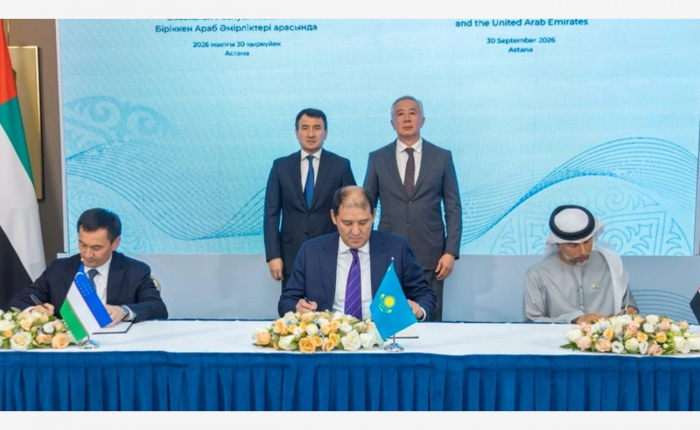
On September 30, 2026, Kazakhstan, Uzbekistan, and the United Arab Emirates took another step toward forming a new transport corridor between Central and South Asia. The Ministries of Transport of Kazakhstan and Uzbekistan, along with the Ministry of Energy and Infrastructure of the UAE, signed a Memorandum of Understanding on cooperation within the Central Asia to South Asia railway project, known as CASA. The proposed route is expected to run through Kazakhstan, Uzbekistan, Afghanistan, and Pakistan, providing access to the seaports of Pakistan. This does not yet mean the start of construction or even an adopted investment decision. The signed document opens the stage of technical and economic development. The parties intend to assess the necessary railway infrastructure and related facilities, conduct analytical research, and determine possible mechanisms for project implementation. The creation of a joint working group on technical, economic, and financial issues is also under consideration.
Geography has defined the foreign trade of Central Asia for decades. Kazakhstan, Uzbekistan, Kyrgyzstan, Tajikistan, and Turkmenistan do not have direct access to the open ocean, and Uzbekistan is also one of only two countries in the world that are doubly landlocked. Naturally, Central Asia aims to consistently expand the geography of its transport outlets and seeks to turn the lack of direct sea access from a limitation into a system of multivector land connections. Therefore, the issue of transport corridors is of not only commercial but also strategic importance for the region. Today, Central Asia is effectively building several directions for access to external markets at once. Northern routes connect it with Russia and further with Europe. The Transcaspian International Transport Route moves cargo through Kazakhstan, the Caspian Sea, Azerbaijan, and Georgia to Turkey, the Black Sea, and Europe. Southern directions provide connectivity through Turkmenistan and Iran. Simultaneously, the railway connecting China, Kyrgyzstan, and Uzbekistan is under development.
Now, yet another vector is taking shape more clearly, extending through Afghanistan to Pakistan and the Indian Ocean. However, this does not necessarily mean competition between one route and another. Rather, a transport system is being created in which Central Asian states attempt to avoid critical dependence on a single direction. The Middle Corridor is indicative in this regard. According to PMC Research, cargo flow along this route through Georgia reached 4.6 million tons in 2025, doubling the 2018 level. At the same time, regional trade currently forms the bulk of these flows, rather than long distance transit between China and Europe. Thus, the task for Central Asia is no longer simply to find one short path. The main goal becomes the diversification of transport geography.
The new memorandum of Kazakhstan, Uzbekistan, and the UAE effectively overlaps with the Transafghan Railway project, which has been developing for several years. On July 17, 2025, Uzbekistan, Afghanistan, and Pakistan signed a trilateral framework agreement in Kabul to develop a feasibility study for a railway along the Termez, Nayabad, Maidan Shahr, Logar, and Kharlachi route. After connecting to the Pakistani railway network, cargo is intended to be directed further to seaports. Uzbek sources indicate the possibility of integrating the route with the Peshawar to Karachi line and further access to Karachi and Qasim.
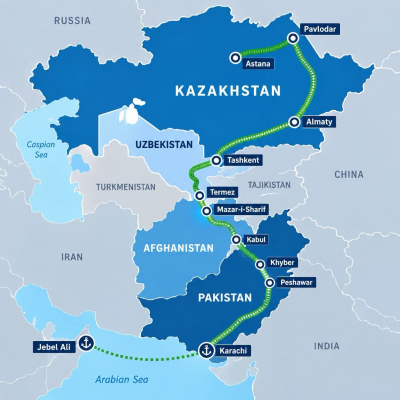
In February 2026, the President of Uzbekistan, Shavkat Mirziyoyev, approved the framework agreement signed in Kabul, assigning the Ministry of Transport of Uzbekistan as responsible for its implementation. Therefore, the agreement of September 30 should be viewed not as the emergence of a completely new route, but as an expansion of the Transafghan transport concept. If the core of the project was initially the Uzbekistan, Afghanistan, and Pakistan nexus, Kazakhstan is now directly joining it, while the UAE enters the project as a potentially vital infrastructure and investment partner. For Kazakhstan, CASA creates a potential southern direction toward the Indian Ocean. Kazakhstan already possesses several foreign trade routes, including Russian, Caspian, and Iranian directions. Therefore, CASA should hardly be considered a replacement for existing corridors. The value of this path lies in the emergence of yet another option. Astana interest in the Afghan direction manifested even earlier. In 2025, Kazakhstan discussed participation in the construction of the Torghundi to Herat railway, which is also considered an element of future transport connectivity with southern markets. Thereby, Kazakhstan is gradually forming several southern transport opportunities at once. For the largest economy in Central Asia, this means potential access not only to ports but also directly to the markets of Afghanistan and Pakistan, and further to South Asia.
For Tashkent, the Transafghan railway has perhaps even greater significance. Uzbekistan is located in the center of Central Asia but lacks direct access to maritime communications. Almost any of its exports beyond neighboring states require crossing the territory of at least one more country. Therefore, the transport policy of Tashkent is increasingly aimed at turning the geographical position of the country from a disadvantage into an advantage. In the east, the railway connecting China, Kyrgyzstan, and Uzbekistan is under development. In the west, Uzbekistan gains access to the Caspian Sea and further through Azerbaijan and Georgia. In the south, the Iranian direction exists. Meanwhile, the Transafghan railway potentially opens a direct axis to Pakistan. In the event of CASA implementation, Uzbekistan turns out to be not the endpoint of a transport route, but a central hub connecting East, Central, and South Asia.
The third participant in the memorandum is no less interesting. The UAE is not geographically located on the Kazakhstan, Uzbekistan, Afghanistan, and Pakistan route. Their participation should therefore be considered primarily through the prism of infrastructure, logistics, financing, and international trade. While Kazakhstan and Uzbekistan possess developed railway infrastructure and transit potential, the UAE has international experience in implementing major transport, logistics, and investment projects. It is precisely the presence of a financial and infrastructure partner that may prove to be one of the most important elements of the new configuration. Building a railway through Afghanistan will require more than just laying tracks. Terminals, border infrastructure, logistics centers, transport management systems, financing, and subsequent commercial operation are all necessary. Therefore, the question is not only who will build the railway, but also who can turn it into a functioning international logistics corridor.
On the map, the route looks logical. In reality, however, the Afghan section will become the most complex part of the project. A significant volume of new railway infrastructure must be built in complex geographical conditions. It will be necessary to harmonize railway technical standards, border and customs procedures, tariffs, transport safety, operator liability, and transit procedures. Connecting railway systems with different technical standards will become a separate task. But there is a more fundamental question, namely the enduring predictability of Afghanistan as a transit territory. For an international cargo owner, it is not enough for the railway to physically exist. They must understand that the train will complete the route on time, the cargo will be insured, the tariff will not change unexpectedly, border procedures will be clear, and the transport will not stop due to a political or security crisis. Therefore, building the infrastructure is only half of the project. The second half involves building trust in the corridor.
However, there is another problem that sometimes gets lost behind geopolitical reasoning. A railway corridor exists economically only when there is cargo moving along it. Moreover, it is desirable in both directions. According to data provided by Interfax with reference to project plans, the potential capacity of the Transafghan direction is estimated at up to 10 million tons of cargo per year to the Pakistani ports of Karachi and Gwadar. But potential capacity and actual cargo flow are different things. Before making an investment decision, it is necessary to understand exactly which goods will go from Kazakhstan and Uzbekistan to Pakistan, which cargo Pakistan can send to Central Asia, what the guaranteed annual volume will be, and how competitive the rate will turn out to be. It is precisely here that the fate of CASA will be decided. The corridor will have to compete not with a map, but with real alternatives. The shipper will compare the cost and delivery time via Russia, the Caspian Sea, Azerbaijan, and Georgia, as well as Iran, and Afghanistan and Pakistan. If CASA proves to be faster, cheaper, or provides access to markets that are difficult to reach effectively by other routes, the cargo base will form naturally. If not, the railway risks gaining strategic importance but insufficient commercial loading. It is especially important not to oppose CASA to the Middle Corridor.
For Kazakhstan and Uzbekistan, these directions solve different tasks. The Middle Corridor is primarily oriented westward through the Caspian Sea, Azerbaijan, and Georgia to Turkey, the Black Sea, and European markets. CASA is directed southward to Pakistan, the Indian Ocean, and South Asian markets. The Iranian direction provides another outlet to the Persian Gulf. Together, they create what Central Asia has historically lacked, which is choice. This is precisely why the transport strategy of the region is gradually changing. The question no longer sounds like which country to use to reach the sea. The new question is how many independent routes to the sea Central Asia can have and how to make them compete with each other for cargo. The more economically viable corridors Kazakhstan and Uzbekistan have, the less the region depends on the political, military, or infrastructure situation in any single direction.
Elbrus Mamedov

