
 Home
HomeThe Union of Baku and Tashkent Changes the Architecture of Central Asia and the South Caucasus
-
 26 Aug 2026 08:30
-
 299
299
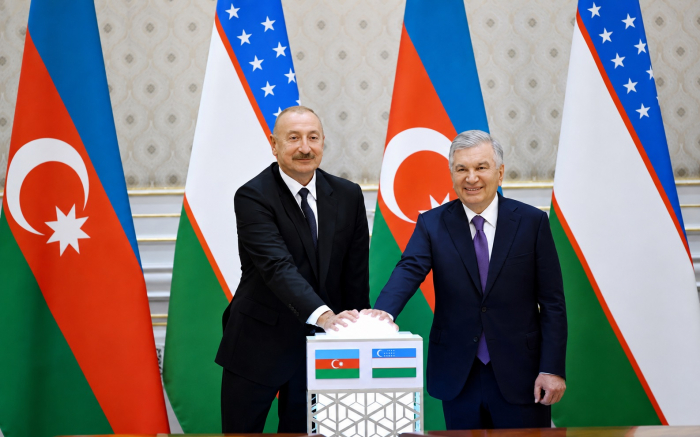
On August 23, 2026, the President of Azerbaijan Ilham Aliyev arrived in Uzbekistan on a state visit. An honor guard was formed in honor of the Azerbaijani head of state at the Tashkent Khumo International Airport. Ilham Aliyev and First Lady Mehriban Aliyeva were personally greeted by the President of Uzbekistan Shavkat Mirziyoyev and his wife Ziroatkhon Mirziyoyeva.
Today, Azerbaijan and Uzbekistan are effectively forming one of the most dynamic political and economic tandems in the former Soviet space. Over the past few years, relations have evolved from a strategic partnership to a legally formalized alliance. This alliance is gradually expanding far beyond the limits of exclusively bilateral relations. Modern Azerbaijani and Uzbek relations have a serious historical foundation. Azerbaijan and Uzbekistan emphasize the commonality of language, culture, religion, traditions, and historical ties. The historical foundation of the current interaction was laid in 1997 when the official visit of Heydar Aliyev to Uzbekistan concluded with the signing of key documents that defined the vector of future cooperation. However, the genuine acceleration of bilateral processes occurred in recent years when relations transitioned into a phase of qualitatively new rapprochement. A bright indicator of this dynamic is the exceptional intensity of personal contacts between Ilham Aliyev and Shavkat Mirziyoyev. Over the past five years, the heads of state have exchanged twelve visits, including state and working trips in both directions. Such frequency of highest level meetings testifies to the unconditional priority of this direction for both capitals. This rich political agenda has naturally grown into a deep institutional formalization of ties, elevating the dialogue between Baku and Tashkent to the level of strategic predictability.
The Declaration on Deepening Strategic Partnership and Expanding Comprehensive Cooperation, the Treaty on the Establishment of the Supreme Interstate Council, and finally the Treaty on Allied Relations between Azerbaijan and Uzbekistan were signed. Baku and Tashkent are no longer limited to the formula of friendly states or even strategic partners. A political and legal construction of an alliance has been created, which now must be filled with economic, transport, investment, and regional content.
It is precisely in this logic of institutional building that the state visit of Ilham Aliyev on August 23 and 24, 2026, should be considered. The key event of the trip will be the third meeting of the Supreme Interstate Council, established in August 2023. Following the founding meeting in Tashkent in 2024 and the reciprocal session in Baku in 2025, this format is gaining stable regularity, turning into a permanently functioning mechanism for highest level coordination. Such rhythm of the Council work fundamentally distinguishes the current stage of Azerbaijani and Uzbek relations from the declarative strategic partnerships common in international practice. Observers are witnessing a picture of genuine institutional formalization of the alliance, backed by a solid treaty and legal base numbering around 220 documents. It is expected that during the current visit, this array will be supplemented with new agreements across a wide spectrum of directions.
Baku and Tashkent are consistently building a branched institutional framework of the union, which ensures not only current coordination but also long term predictability of bilateral interaction. The most significant aspect of what is happening goes beyond the exclusively bilateral agenda. For decades, Central Asia was conventionally viewed as a space uniting Kazakhstan, Kyrgyzstan, Tajikistan, Turkmenistan, and Uzbekistan. This configuration historically became entrenched in the diplomatic lexicon under the designation C5. However, modern geoeconomic reality is transforming this established construct, and Azerbaijan plays one of the key roles in this process. President Ilham Aliyev participated in the fifth and sixth consultative meetings of the heads of state of Central Asia in 2023 and 2024 as an honorary guest. Then, at the seventh meeting in Tashkent on November 16, 2025, the decision on the full participation of Baku in this format was cemented. Such evolution marks a factual transition from the C5 model to a new C6 configuration.
This change carries a much deeper meaning than a simple expansion of the diplomatic list of participants. Despite the fact that Azerbaijan is geographically located in the South Caucasus, in the geoeconomic dimension it is integrating into the Central Asian space ever more deeply. The Caspian Sea is ceasing to be perceived as a barrier separating the two macroregions. It is acquiring a fundamentally new function as a connecting link, uniting them into a single economic and transport space.
Political rapprochement gains genuine sustainability only when backed by developed material infrastructure. In this dimension, the indicators of Azerbaijani and Uzbek interaction acquire special expressiveness. In 2025, the volume of transit shipments between the two countries reached 1.4 million tons, which pushes cooperation far beyond symbolic figures and translates it into the category of full fledged economic partnership.
For Uzbekistan, which has no direct access to the World Ocean, the diversification of transport routes is not merely a logistics task but a matter of long term economic strategy. Azerbaijan in this configuration naturally occupies the position of one of the key transit hubs in the western direction. That is exactly why the development of the Middle Corridor forms a fundamentally new economic basis for the relations between Baku and Tashkent.
The scale of Central Asian cargo flows directed through the Caspian Sea directly determines the significance of Azerbaijani transport infrastructure. In turn, the efficiency of ports, railways, and western transport connections of Azerbaijan enhances the attractiveness of this route for Uzbek shippers. A stable synergy emerges in which transport interdependence ceases to be merely a logistics issue and begins to organically reinforce the political alliance of the two countries. The economic agenda of bilateral relations is steadily evolving from classical trade to deep production cooperation and mutual investments. The presence of more than 130 Uzbek companies in the Azerbaijani market, including their active participation in reconstruction projects in the liberated territories, serves as a clear confirmation of this trend. A bright indicator of industrial synergy is the joint venture involving the Azermash company, which in close cooperation with Uzbek partners is successfully implementing projects for the production of Chevrolet and Isuzu vehicle brands.
A joint investment company established in 2023 deserves special attention. Its key mission is to finance promising initiatives in the territories of both states. The effectiveness of the dialogue is additionally ensured by the work of the Intergovernmental Commission, which has held 15 meetings to date, the latest of which took place on July 17, 2026, in Tashkent. The creation of such a financial structure is of fundamental importance since it forms a reliable mechanism for the practical implementation of the allied policy of the two countries.
Scaling up this financial instrument will allow Baku and Tashkent to move from declarations of cooperation to joint capital entry into large scale industrial, logistical, energy, and infrastructure projects. It is precisely such mechanisms that transform political partnership into a deep and irreversible economic interdependence. A separate mention is deserved by the established history of interaction in the energy sector. Back in 2016, a joint venture named Neftegaztexnologiya was established on the basis of the Uzbek institute OZLITINEFTGAZ and the SOCAR NIPI Nefteqaz structure, successfully functioning in the oil and gas sector.
In parallel, interaction within the Organization of Turkic States is deepening. Both Baku and Tashkent see in this structure not just a diplomatic platform but an effective mechanism for consolidating the political, economic, and cultural ties of the Turkic space. In current expert discourse, there is a clear aspiration to strengthen the organization, achieve greater unity of the Turkic world, and increase its aggregate geopolitical weight. In this architecture, the positions of Azerbaijan and Uzbekistan possess unique complementarity. Azerbaijan acts as a natural bridge connecting the Central Asian states with Turkey. Uzbekistan has the largest demographic potential among the organization participants from Central Asia, backed by a powerful industrial and political base. Consequently, the strategic alliance of these two countries can become one of the fundamental pillars for the further institutional development of the entire Turkic community.
A characteristic feature of the current stage of relations between the two countries is the consistent decentralization of interaction. The parties are systematically transferring cooperation from the plane of exclusively presidential and governmental contacts to the level of direct regional dialogue. A clear confirmation of this trend is the holding of the fourth Joint Interregional Forum in Tashkent on August 22. This platform demonstrates enviable regularity, consistently uniting delegations in Tashkent, Guba, and Baku over the past three years. As a result, a branched network of sister cities has been formed, covering Baku and Tashkent, Shusha and Khiva, Lankaran and Bukhara, Sheki and Kokand, Mingachevir and Namangan, Fuzuli and Gulistan, Guba and Jizzakh. In the future, it is planned to establish new sister city ties between Urgench and Nakhchivan, Urgench and Khankendi, as well as Bukhara and Lachin. Such dynamics testify to the formation of a horizontal infrastructure of relations where not only capitals but also regions, business circles, academic, and public institutions interact.
The participation of Uzbekistan in the reconstruction of the liberated territories of Azerbaijan acquires special political and symbolic significance, where the city of Fuzuli is effectively becoming a symbol of the special closeness of the two peoples. At the initiative of the Uzbek side, a modern school named after Mirzo Ulugbek was built in Fuzuli, designed for 960 students and featuring forty classrooms, six laboratories, as well as developed infrastructure for education and sports. In the current academic year, 583 students have taken their seats at the desks here. In parallel, a large scale Friendship Garden project is being implemented on an area of about one hundred hectares, involving the joint cultivation of Azerbaijani and Uzbek pomegranate varieties. Such initiatives possess value that far exceeds purely economic indicators. In turn, a five hectare Uzbekistan park has been laid in Baku. In the future, this space will become a multifunctional center uniting museum exhibitions, an amphitheater, and objects of culture, gastronomy, and tourism, which will finally cement the Uzbek presence in the cultural landscape of the Azerbaijani capital.
The dialogue between Azerbaijan and Uzbekistan has long moved beyond dry official protocols, filling with mutual days of culture, joint scientific initiatives, and regular parliamentary meetings. A telling symbol of this mutual respect is Heydar Aliyev Square in the very heart of Tashkent. A sustainable dynamic has also been acquired by professional dialogue, as evidenced by the first joint media forum held in Tashkent in 2024 and the reciprocal meeting in Baku a year later. The initiative of the nongovernmental sector also deserves special attention, where in 2026 a joint grant competition was announced for the first time. This unique practice involves mutual implementation of projects where Azerbaijani initiatives find embodiment in the territory of Uzbekistan, while Uzbek programs successfully operate in Azerbaijan.
GSR

