
 Home
HomeXi Jinping's New Security Concept and the Future of the SCO
-
 06 Sep 2026 09:42
-
 181
181
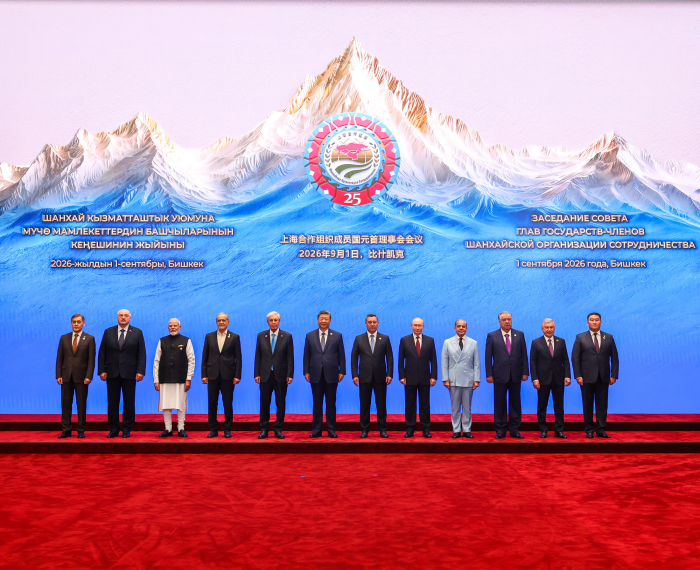
The most crucial direction outlined by PRC Chairman Xi Jinping in his speech at the twenty sixth meeting of the Council of Heads of State of the Shanghai Cooperation Organization in Bishkek was security. The Chinese leader dedicated a significant portion of his address to this issue, and the approach he proposed shows that the very understanding of security within the SCO is expanding noticeably. This is no longer just about the traditional fight against terrorism, extremism, and separatism, but also about forming a more comprehensive system to protect the Eurasian space from new transnational, digital, biological, and technological threats.
Xi Jinping speaks about transnational organized crime, drug trafficking, and telecommunications fraud. Simultaneously, issues of information, biological, and space security are being included in the SCO agenda.
The latter three directions are particularly indicative, as this is no longer simply about fighting crime or armed groups. These are spheres upon which the functioning of a modern state, its economy, communications, energy, financial system, and critical infrastructure directly depend. Information security acquires special significance as the economy and state administration become increasingly digitalized. The more services, financial operations, transport systems, and state functions transition into the digital environment, the more serious the consequences of cyberattacks, data leaks, interference in information systems, and other digital threats become.
Biological security, following the events of recent years, has also ceased to be perceived as an exclusively medical issue. Epidemics can impact healthcare, the economy, transport, international trade, and social stability almost simultaneously. Therefore, cooperation in this sphere is gradually becoming part of a broader system of national and regional security.
Even more interesting is the appearance of space security in this list. The modern economy is already difficult to imagine without satellite navigation, communications, remote sensing of the Earth, meteorological data, and other space technologies. Transport, agriculture, logistics, telecommunications, and many elements of defense infrastructure depend on them. Therefore, the inclusion of information, biological, and space security in the SCO agenda shows how much the very understanding of threats has changed over the twenty five years of the existence of the organization. If regional security was previously largely associated with border protection, the fight against terrorism, and the prevention of political instability, today a state must simultaneously protect digital networks, financial systems, the biological environment, communication channels, satellite infrastructure, and massive data arrays. As a result, the SCO is gradually moving to a completely different level of cooperation. This is no longer just about the interaction of law enforcement agencies and special services. Technology companies, scientific institutions, the telecommunications sector, medicine, transport operators, and digital technology specialists are inevitably drawn into security issues.
This is especially important against the backdrop of the fact that in the first part of his speech, Xi Jinping simultaneously called for the development of artificial intelligence, the digital economy, and new technologies. The more deeply states are technologically connected, the more they will need joint mechanisms to protect this infrastructure. This results in a fairly logical construct. China proposes that SCO countries simultaneously develop new technologies and create mechanisms to protect the technological environment that will emerge as a result of this development. This is precisely why the expansion of the security agenda should be viewed not separately from the economic initiatives of Xi Jinping, but as their continuation. If the SCO is indeed moving toward closer economic, digital, and technological interconnectedness, it will inevitably have to create its own system for protecting this space.
A separate place in the speech of Xi Jinping was taken by the issue of interference by external forces in the internal affairs of states. The Chinese leader directly called for countering actions that could threaten the political security of individual countries and the stability of the entire region. For China, this is a principled position that has remained one of the foundations of its foreign policy for many years. State sovereignty, territorial integrity, and noninterference in internal affairs are viewed by Beijing as mandatory conditions for normal relations between countries. However, within the SCO, this principle acquires a broader significance. Many Eurasian states are extremely sensitive to any attempts at external influence on their domestic politics. Therefore, the idea that each state independently determines its political system, development model, and foreign policy course becomes one of the important points of contact between the very different participants of the organization.
It is precisely on this basis that Xi Jinping proposes developing the concept of common, comprehensive, cooperative, and sustainable security. Its meaning lies in the fact that the security of one state cannot be ensured for long at the expense of the security of another. Threats in the modern world are too closely interconnected and increasingly cross state borders. Terrorism, drug trafficking, organized crime, cyber threats, biological risks, and telecommunications fraud cannot be effectively contained exclusively by national means. Even large states are forced to exchange information, coordinate actions, and create permanent mechanisms of interaction. Therefore, Xi Jinping proposes making the SCO one of the important platforms for the practical implementation of the Chinese Global Security Initiative. Thus, another global concept of Beijing gains a concrete regional foundation.
It is especially important that the discussion is gradually shifting from political principles to the creation of real security infrastructure. China has advocated for the earliest possible launch of four SCO centers, which should enhance the capabilities of the member states in countering modern threats. The decisions of the Bishkek summit show that this process is already beginning. The Regulation on the Universal Center for Countering Security Challenges and Threats of SCO Member States was approved, as well as the Regulation on the Executive Committee of the SCO Counter Narcotics Center. The very appearance of such permanent structures is of great significance. The organization is gradually acquiring specialized institutions capable of dealing with specific areas of security on a permanent basis. In the future, this could noticeably change the role of the SCO. The more permanent mechanisms for information exchange, coordination, and joint response appear within the organization, the less it resembles a platform for periodic political consultations and the more it becomes a complete system of regional interaction.
At the same time, it is fundamentally important what character this system will have. In the model proposed by China, the discussion is not yet about creating a collective military alliance along the lines of traditional military and political blocks. The SCO is proposed to be developed as a mechanism of joint security, under which states retain their independence but gain the opportunity to respond together to threats that cannot be effectively stopped within national borders. It is precisely the combination of two principles that makes the Chinese proposal particularly interesting. On one hand, there is the strict protection of state sovereignty and noninterference in internal affairs. On the other hand, there is the recognition that in the face of modern transnational threats, a single national sovereignty is no longer sufficient, and states require much closer practical interaction. How successfully these two approaches can be combined will largely determine whether the SCO can form its own effective security model for the vast Eurasian space in the coming years.
GSR

