
 Home
HomeXi Jinping — The New Role of the SCO in a Changing World
-
 04 Sep 2026 08:52
-
 256
256
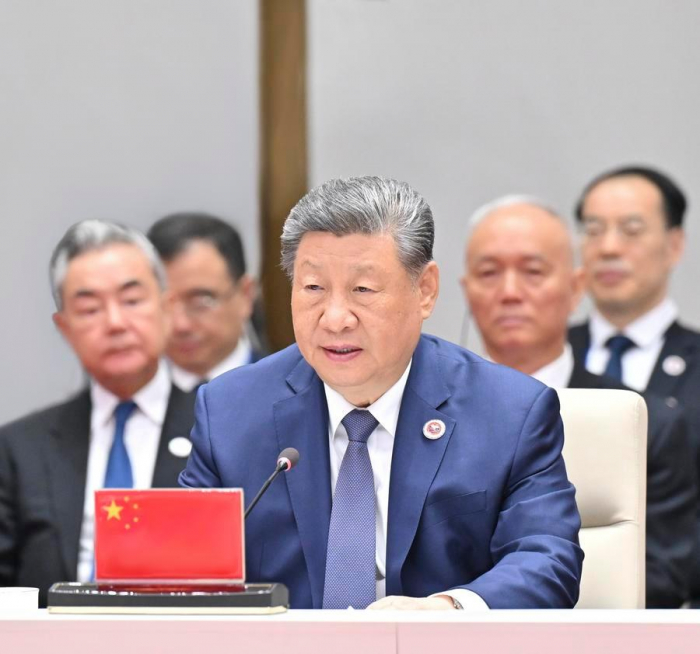
On September 1, 2026, in Bishkek, President of the People’s Republic of China Xi Jinping addressed the 26th Meeting of the Council of Heads of State of the Shanghai Cooperation Organization, held in the year marking the SCO’s 25th anniversary. The meeting brought together the leaders of some of Eurasia’s largest states, while the organization itself approached its anniversary in a form very different from that in which it began its journey a quarter of a century ago.
Xi Jinping’s speech was rich in ideas whose significance extends far beyond the SCO itself. The Chinese leader spoke not only about the future of the organization. His remarks addressed issues that today are largely shaping the direction of global development: what the emerging world order will look like, what place large and small states will occupy within it, how security and development should be combined, what will happen to the global economy amid growing confrontation, what role artificial intelligence, the digital economy and green technologies will play, and, finally, how the system of global governance itself should evolve.
Moreover, Xi Jinping did not limit himself to general reflections on multipolarity and the need for international cooperation. A significant part of his speech was devoted to specific areas and mechanisms of cooperation. China proposed expanding cooperation in artificial intelligence, the digital economy, energy, green industries and science; establishing an international center for cooperation on the application of artificial intelligence for SCO countries; implementing 100 joint scientific and technological projects over the next three years; developing transport routes; and improving the efficiency of the Trans-Caspian International Transport Route. New areas of cooperation in security, education and humanitarian exchanges were also outlined.
For this reason, the speech is worth examining not simply as another set of Chinese initiatives within the SCO, but as an attempt to articulate a broader vision of how Beijing sees the next stage of Eurasia’s development and the role the SCO could play in the ongoing transformation of the international system. It is particularly significant that Xi Jinping grouped his main proposals into four broad areas: development, security, people and governance. Behind this seemingly simple formula lies a much more comprehensive framework.
Economic development is linked to trade, investment, transport, energy, artificial intelligence, the digital economy and emerging technologies. Security is understood far more broadly than counterterrorism alone and now encompasses information, biological and even space security. The human dimension implies the creation of sustainable ties among universities, think tanks, businesses, media organizations and societies across different countries. Governance, meanwhile, brings the SCO directly into the discussion about the future of the international system and the principles of an emerging multipolar world.
As a result, a fundamentally different role for the SCO is beginning to take shape. An organization created a quarter of a century ago primarily around regional security and mutual trust is gradually seeking to encompass economics, technology, transport, energy, security, education and global governance. It is from this perspective that Xi Jinping’s key messages deserve closer examination in order to understand what they mean not only for China and the SCO member states, but also for the broader system of relations now taking shape across Eurasia.
Speaking about the SCO’s 25-year journey, Xi Jinping recalled the international circumstances in which the organization was established. At that time, countries in the region were simultaneously confronting the consequences of the Cold War, terrorism, extremism and separatism — phenomena that came to be described in SCO documents as the “three evil forces.” No less important was the desire of states to independently safeguard their sovereignty, security and right to development. Yet what deserves particular attention in this part of the speech is not so much the reference to history as the conclusion the Chinese leader draws from it. According to Xi Jinping, the SCO has succeeded in developing its own model of relations among states, one that has demonstrated its viability over the past quarter century. This, perhaps, provides one of the keys to understanding why the SCO continues to expand. The organization has brought together states that differ considerably in their political systems, economic size, cultures, foreign-policy interests and relations with other global centers of power. At the same time, they are not required to standardize their political systems or fully align their positions on international issues.
Over the past 25 years, the SCO has grown from a relatively small regional structure into one of the world’s largest international organizations in terms of the territory, population and economic potential of its member states. For Xi Jinping, however, the most important result of this journey lies not so much in the organization’s scale as in its ability to preserve the principles on which it was founded. This is why he once again turns to the concept of the “Shanghai Spirit.” At its core are mutual trust, mutual benefit, equality, consultation, respect for cultural diversity and the pursuit of common development. Yet another principle emphasized by Xi Jinping appears particularly relevant to today’s international environment: non-alignment, non-confrontation and non-targeting of third parties. These principles represent a significant departure from the traditional logic of military-political alliances. In the classical system of international relations, the consolidation of one group of states has often been based on the identification of a common adversary. China proposes a different logic. Countries do not necessarily need to unite against someone else in order to cooperate with one another.
This is especially important today, as the international system becomes increasingly polarized and states are more frequently pressured to determine which camp they belong to. The model proposed within the SCO leaves considerably more room for an independent foreign policy. A country can develop relations with China, Russia, the Central Asian states, India, Iran and other SCO members while simultaneously maintaining economic and political ties with Europe, the United States, Türkiye, the Arab world and other centers of power.
For this reason, the principle of not targeting third countries has significance far beyond the organization itself. If this principle is preserved as the SCO continues to expand, the organization may evolve not into another bloc confronting an opposing group of states, but into a space where countries with different interests can cooperate wherever those interests coincide. For contemporary Eurasia, where the interests of China, Russia, India, Türkiye, Iran, the European Union and other actors intersect simultaneously, such a model may become one of the essential conditions for preserving space for dialogue and economic cooperation. Perhaps one of the most important parts of Xi Jinping’s speech concerns not the SCO itself, but the broader transformation taking place within the international system.
The Chinese leader once again referred to “changes unseen in a century,” but in this case the familiar formulation acquires a very concrete meaning. In his assessment, the world is increasingly facing a choice between two different approaches to international relations. On one side are dialogue, mutually beneficial cooperation and multilateralism. On the other are confrontation, zero-sum thinking and attempts by individual states to act unilaterally. It is against this background that Xi Jinping speaks about the continuing threat of wars and effectively raises the question of what the international system should look like at a time when established rules and the global balance of power are undergoing significant change.
He stresses that the SCO should assume its historical responsibility and participate more actively in these processes. This represents a much more ambitious vision than simply strengthening cooperation among the organization’s member states.
China is effectively proposing that the SCO gradually move beyond the role of a regional platform and become one of the participants in the discussion over the future world order. This does not mean that the SCO is intended to replace existing international institutions or become a new center of global dominance. Rather, Beijing appears to be proposing an additional pillar of an emerging multipolar world in which decisions on major international issues should not depend exclusively on a single state or a single group of countries. This also helps explain why China attaches such importance to the SCO’s expansion and to attracting new partners. The broader the organization’s geographical reach and the greater the number of states participating in its economic, political, technological and humanitarian mechanisms, the more influential its voice can become in international affairs. It is particularly important that the SCO brings together countries with very different interests and foreign-policy orientations. There is no complete consensus among them on many international issues, and in a certain sense this may actually be one of the organization’s strengths. If such diverse countries are capable of finding common ground without requiring complete political uniformity, the SCO may indeed offer one possible model of relations in a multipolar world.
Xi Jinping’s words about the SCO’s historical responsibility should therefore be taken seriously. China is gradually proposing that the organization be viewed not only as one of the mechanisms for maintaining stability in Eurasia, but also as a platform capable of contributing to the formation of new principles of international interaction. It is no coincidence that Xi Jinping placed development first among the four priorities. From the Chinese perspective, the stability of the vast Eurasian space cannot be ensured solely through political agreements and security mechanisms. States must have an economic stake in one another through joint projects, trade, investment, transport routes and gradually developing common production chains.
This is why Xi Jinping called on SCO countries to support inclusive economic globalization whose benefits should be shared by all participants. Against the backdrop of growing discussion about the fragmentation of the global economy, trade wars, sanctions and the division of markets, this proposition takes on particular significance. China is effectively advocating the preservation of open economic ties and the continued expansion of trade and investment across the Eurasian continent. At the same time, the meaning of development itself is changing considerably. It is no longer limited to increasing mutual trade, building roads or implementing energy projects. Xi Jinping placed trade, investment, transport connectivity, energy and natural resources alongside artificial intelligence, the digital economy, green industries and green mining.
This combination of traditional and emerging sectors deserves particular attention. China is proposing not merely to increase trade turnover within the SCO, but gradually to create a new economic foundation for cooperation in which transport and energy are complemented by technology, digital solutions, scientific research and modern manufacturing. The economic dimension of Xi Jinping’s speech therefore goes far beyond a conventional call to increase trade among SCO countries. In essence, the objective is gradually to transform the organization’s vast geographical space into an area of deeper economic, industrial and technological interconnectedness. If this model begins to be implemented in practice, the SCO could gradually move from predominantly political coordination toward the formation of a space in which states are connected not only by a shared interest in stability, but also by concrete economic interests, joint production, technology and infrastructure.
GSR

