
 Home
HomeThe South Caucasus Between American Geopolitics and Chinese Economic Integration
-
 03 Aug 2026 10:19
-
 242
242
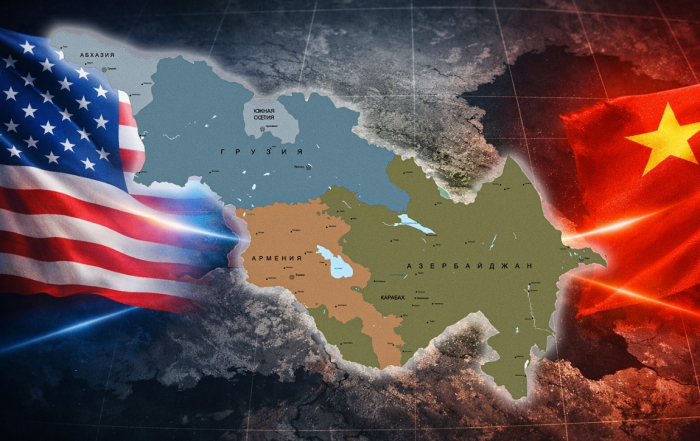
The South Caucasus is rapidly redefining its role on the world stage. Once a peripheral transit zone, the region is emerging as a pivotal node linking China, Central Asia, the Caspian Sea, the Black Sea, Turkey, and Europe. As traditional trade routes increasingly run into sanctions, armed conflicts, and overburdened maritime corridors, businesses are actively seeking new overland connections between Asia and Europe. The South Caucasus is ceasing to be a mere waystation — it is becoming an indispensable link in Eurasian logistics.
For China, the region holds particular strategic interest. Beijing has been steadily diversifying its international trade routes, expanding the Belt and Road Initiative, and building new production and logistics chains. The South Caucasus is well positioned to become one of the key corridors in this process, as it provides the shortest overland route between the Caspian and Black Seas.
The United States is also paying increasing attention to the region. However, the American and Chinese approaches differ markedly in their priorities, instruments, and long-term logic. For Washington, the South Caucasus remains first and foremost a critical geopolitical space situated between Russia, Iran, Turkey, Central Asia, and the Black Sea. American policy has traditionally placed strong emphasis on security, the sovereignty of regional states, political institutions and their reform, energy routes, and containing the influence of geopolitical competitors. Economic projects in the American framework are typically subordinated to a broader political strategy. Cooperation may depend on the state of bilateral relations, a country's domestic politics, compliance with institutional requirements, and the overall international environment. American companies possess enormous financial and technological capabilities, yet large-scale infrastructure investments beyond traditional markets often require lengthy preparation and a high degree of political assurance.
China views the region through a different lens. Beijing sees the South Caucasus primarily as an economic partner, a convenient transit corridor, and a future industrial hub. Its focus is on infrastructure development, trade growth, new logistics routes, energy, and integrating local markets into global value chains. China proceeds from a straightforward pragmatic premise: economic growth and mutual benefit create the strongest foundation for political stability. The more closely countries are bound together through joint enterprises, roads, ports, and trade flows, the greater their incentive to preserve peace. This lies at the heart of what distinguishes the Chinese model. Beijing typically does not demand changes to a country's political system, does not dictate foreign policy choices, and emphasizes respect for sovereignty. Priority is always given to concrete projects, sound economic calculation, and the long-term interests of all parties.
Naturally, Chinese projects still require careful scrutiny. Any large-scale investment must rest on transparent financing, realistic timelines, guaranteed cargo flows, and a clear allocation of risks. Yet in the realities of the South Caucasus, the Chinese approach offers a significant advantage: it addresses the region's most pressing needs. What is needed here today is not grand political declarations but concrete action — modern ports, railways, terminals, industrial zones, and direct access to Asia's vast markets.
For the South Caucasus, these two approaches are by no means mutually exclusive. However, it is the Chinese model that offers a clearer mechanism for converting advantageous geography into tangible economic gains. Global experience confirms that many countries have successfully leveraged partnerships with China to achieve economic breakthroughs while maintaining strong relations with the United States, Europe, and other major players.
Singapore offers one of the most compelling examples. The city-state maintains close ties with the United States in security, finance, and technology. At the same time, China is Singapore's largest trading partner, and Singaporean capital plays a significant role in the Chinese economy. Singapore has not allowed its relationship with one great power to develop at the expense of confrontation with the other. It has managed to combine access to American technology and global financial markets with the benefits of China's economic growth. Crucially, Singapore did not limit itself to the role of a transit port — it evolved into a financial, industrial, innovation, and governance hub.
For the South Caucasus, this experience is of fundamental importance. A favorable geographic position alone does not guarantee prosperity. The region needs efficient ports, digital customs systems, unified transport documentation, financial services, quality education, manufacturing facilities, and transparent rules for international business. China can play a distinctive role in building such a system. It possesses unparalleled experience in transforming transport infrastructure into a foundation for industrial development. The Chinese model assumes that ports, railways, and logistics hubs should give rise to enterprises, warehouses, technology parks, processing zones, and export-oriented manufacturing.
Vietnam provides another instructive example. Despite a complex historical relationship, it has managed to build large-scale, mutually beneficial economic cooperation with both China and the United States simultaneously. Chinese companies supply Vietnam with equipment, components, materials, and intermediate goods. Vietnamese factories use these inputs to produce finished goods that are then exported to the United States, Europe, and other markets. As a result, Vietnam has become one of Asia's largest manufacturing centers. It did not choose exclusively a Chinese or an American model, yet its integration into Chinese production chains has been one of the most important drivers of its industrial growth. For the South Caucasus, this example demonstrates that the Middle Corridor should not remain solely a route for transporting Chinese goods. Along its length, enterprises must be established to process raw materials, assemble products, manufacture components, handle packaging, certification, and onward export. If the South Caucasus remains merely a transit territory, it will capture only a limited share of revenue in the form of transit tariffs. But if Chinese cargo flows are complemented by industrial cooperation, the region stands to capture significantly greater added value.
Kazakhstan is a particularly relevant case. The country simultaneously engages with China, Russia, the European Union, the United States, Turkey, and the Gulf states. Yet it is the development of relations with China that has enabled Kazakhstan to substantially strengthen its role in Eurasian logistics. The Silk Road Economic Belt — the overland component of the Belt and Road Initiative — was first unveiled by Chinese President Xi Jinping in Kazakhstan. This carried both symbolic and practical significance: Central Asia was viewed by China not as a periphery but as the central space of a new system of Eurasian trade. Kazakhstan has used Chinese investment to develop dry ports, railway crossings, logistics centers, energy infrastructure, and manufacturing projects. At the same time, it has maintained partnerships with the West and other centers of power. This experience shows that cooperation with China does not necessarily mean abandoning a multi-vector foreign policy. On the contrary, developing infrastructure and trade with China can enhance a country's importance to other international partners as well. The better connected a state is to China and Asian markets, the greater its value to Europe, Turkey, the Gulf states, and international business.
The United Arab Emirates also exemplify a pragmatic model. In the security domain, they maintain close ties with the United States, while simultaneously developing trade, logistics, energy, and technology cooperation with China. For the UAE, China is not only a major market but also a key participant in the development of ports, trade platforms, the digital economy, and international transport routes. The Emirates seek to serve as a bridge between East and West and do not view relations with Beijing as an obstacle to cooperation with Washington. The South Caucasus is capable of adopting a similar approach. Georgia's Black Sea ports, Azerbaijan's energy and logistics infrastructure, and Armenia's technology potential could all become elements of an integrated system connecting the Chinese market with Turkey, Europe, and the Middle East.
Saudi Arabia also demonstrates that strategic ties with the United States can coexist with large-scale economic partnership with China. Washington retains an important role in security and defense, yet Beijing has become the Kingdom's largest trading partner and the principal buyer of Saudi energy resources. As part of its economic diversification program, Saudi Arabia seeks to attract Chinese technology, industrial companies, electric vehicle manufacturers, equipment producers, and renewable energy firms. Riyadh views China not as a temporary source of capital but as one of the key partners in its long-term modernization. For the South Caucasus, the very principle of this interaction is instructive. China can serve not only as a buyer of raw materials or a supplier of finished goods but also as a partner in building entirely new industries — in machine building, energy equipment manufacturing, agricultural processing, electric vehicles, batteries, solar energy, digital logistics, and e-commerce.
Panama offers yet another example of how American strategic influence and Chinese economic activity can coexist. The Panama Canal has historically been of exceptional importance to the United States, yet China is one of the canal's largest users and a significant participant in Panamanian trade and logistics. The Panamanian experience shows that Chinese commercial presence grows most rapidly where well-developed transport infrastructure and connectivity to global commodity flows already exist.
East Africa also provides a range of important lessons. With Chinese participation, railways, highways, ports, energy facilities, and industrial zones have been built. In Kenya, the new railway between Mombasa and Nairobi has significantly improved the country's transport connectivity. Problems with debt burdens and the profitability of certain projects have highlighted the need for realistic financial models. However, it would be wrong to reduce the entire African experience to talk of a so-called "debt trap." Many such claims have proven overly simplistic or unsupported by evidence. In reality, a significant share of the difficulties stemmed from inaccurate forecasts, weak governance, and insufficient integration of infrastructure into national industrial strategies.
In the Western Balkans, Serbia has been the most active in developing cooperation with China. Chinese companies have participated in building bridges, highways, railway infrastructure, industrial enterprises, and telecommunications systems. For Serbia, partnership with Beijing has become one of the tools for accelerated modernization and capital attraction. At the same time, Serbia's aspiration for European Union integration requires aligning Chinese projects with European environmental and competition standards.
In Central Asia, China has already become one of the leading economic partners. Kazakhstan, Uzbekistan, Kyrgyzstan, Tajikistan, and Turkmenistan are all interested in Chinese markets, capital, technology, and infrastructure, while continuing to cooperate with Russia, the European Union, the United States, Turkey, and the Gulf states. Uzbekistan is particularly noteworthy, actively attracting Chinese companies into energy, industry, automotive manufacturing, equipment production, telecommunications, and agriculture. Chinese involvement helps Uzbekistan not only expand trade but also build its own manufacturing capacity.
These examples confirm the effectiveness of the Chinese model and demonstrate that the success of cooperation depends not only on the investor but also on the quality of governance in the recipient country. China can provide technology, financing, and construction capacity, but national authorities must correctly define priorities and oversee project implementation.
For the South Caucasus, this experience suggests that economic cooperation with Beijing should be structured not around individual contracts but around long-term, sector-wide programs. Chinese investors should be offered not a single road or a single terminal but an entire ecosystem encompassing logistics, energy, manufacturing, processing, digital services, and market access.
All the cases examined — from Singapore and Vietnam to Kazakhstan, the UAE, and Saudi Arabia — point to several important conclusions. First, the greatest benefits from cooperation with China accrue to states that have their own long-term development strategy. Chinese investment alone does not guarantee success. It becomes a powerful engine of growth when a state clearly understands which industries it intends to develop and what its place should be in international production chains. Second, infrastructure delivers maximum returns only when a full economic ecosystem forms around it. A port without industry remains just a port; a railway remains merely a transport route; and a free economic zone without manufacturing becomes simply a territory with tax incentives. Third, deepening cooperation with China does not require abandoning partnerships with the United States, the European Union, or other countries. On the contrary, the more modern a country's infrastructure and the more deeply it is integrated into Asian production chains, the more attractive it becomes to all international investors.
This is precisely why the South Caucasus need not make an artificial choice between Washington and Beijing. The United States retains an important role in technology, innovation, finance, and security. The European Union provides access to the largest neighboring market, modern standards, and financial instruments. Turkey is the natural extension of the Middle Corridor and the principal overland bridge to Europe. Yet when it comes to the large-scale economic transformation of the region, it is China today that possesses the most comprehensive set of capabilities. It remains the world's largest industrial center, one of the leading infrastructure investors, the largest participant in Eurasian trade, and the starting point of the Middle Corridor. Without Chinese cargo flows, the Middle Corridor is unlikely to reach its full potential. Without Chinese manufacturing companies, it will be far more difficult for the South Caucasus to transition from a transit territory to an industrial hub. And without full access to the Chinese market, the region's export potential will inevitably remain constrained. Cooperation with China should therefore be viewed not as one among many directions of foreign policy but as one of the key pillars of a long-term economic development strategy for the South Caucasus.
It is within this logic that the idea of creating a network of free and special economic zones across the South Caucasus takes on particular significance. Today, Georgia, Azerbaijan, and Armenia are developing their industrial platforms largely independently. Each country offers its own incentives, infrastructure, and conditions for investors. However, comparatively small domestic markets limit the scale of most projects. For major Chinese corporations, a unified economic space connecting the Caspian and Black Seas, Central Asia, Turkey, Iran, and the European Union would be far more attractive than three separate markets. This does not imply creating supranational governing bodies. Each state fully retains its sovereignty, legislation, customs system, and investment policy. What is being integrated is not states but economic capabilities — through a unified digital platform, coordinated transport routes, joint promotion, and rational specialization.
Over the next decade, the importance of the South Caucasus will grow objectively, driven by the expansion of the Middle Corridor, rising trade between China and Europe, and the development of Central Asia. But growth in transit volume alone does not equate to economic development. The region's central challenge is to convert transport flows into industrial production, new enterprises, jobs, exports, and modern services. If this can be achieved, within the next two decades the South Caucasus could transform from a transit route into one of Eurasia's key manufacturing and logistics hubs. The essential question today, therefore, is not which global power should dominate the region. Far more important is understanding which development model can deliver long-term economic growth.
GSR

