
 Home
HomeChina and Azerbaijan Strengthen Their Strategic Partnership: Beijing’s Interests in the South Caucasus and the New Geography of Eurasia
-
 15 Oct 2026 07:52
-
 99
99
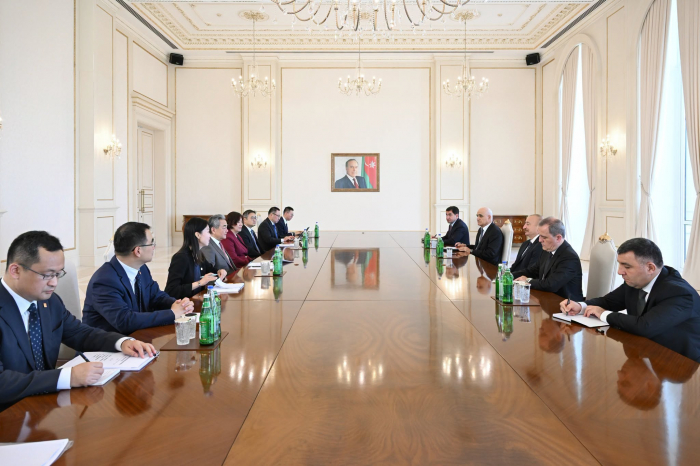
The meeting between Azerbaijani President Ilham Aliyev and Wang Yi, a member of the Political Bureau of the Central Committee of the Communist Party of China (CPC) and China’s Minister of Foreign Affairs, held in Baku on October 14, marked another stage in the development of the comprehensive strategic partnership between China and Azerbaijan. The talks took place against the backdrop of expanding economic cooperation between the two countries, the development of the Trans-Caspian International Transport Route, and the growing importance of the South Caucasus in trade and economic relations linking China, Central Asia, and Europe.
Wang Yi arrived in Azerbaijan as the special representative of Chinese President Xi Jinping to attend the seventh summit of the Conference on Interaction and Confidence Building Measures in Asia (CICA). His visit provided an opportunity to discuss with the Azerbaijani leadership the implementation of previously reached agreements, prospects for economic cooperation, and the coordination of positions on regional and international issues.
The Azerbaijani president emphasized the high level of mutual political trust between the two countries, noting that their relations continue to develop on the basis of mutual support and shared economic interests. Aliyev paid particular attention to the implementation of agreements reached during his visit to China in 2025. According to him, the areas of cooperation agreed upon at that time are being successfully put into practice, creating conditions for bilateral relations to enter a new phase. The Azerbaijani leader also thanked China for its longstanding support for the country’s socioeconomic development and national interests.
During the talks, Aliyev highlighted China’s role in strengthening the position of developing countries. He described China as one of the leading forces behind the rise of the Global South and emphasized that Chinese modernization is of interest to many countries, including Azerbaijan. This statement reflects Baku’s interest not only in Chinese investment and technology but also in learning from China’s experience in economic transformation, infrastructure construction, and industrial development. The Azerbaijani president recalled that his country was among the first to support the Belt and Road Initiative and participate in its implementation. He praised the results of completed joint projects and expressed readiness to continue cooperation by expanding China’s involvement in Azerbaijan’s economic development and new initiatives.
Energy, transport connectivity, and the growing presence of Chinese companies in the Azerbaijani market were identified as priority areas. Aliyev also addressed people-to-people exchanges, proposing more active use of the mutual visa-free agreement to expand contacts between citizens, entrepreneurs, and academic and educational institutions of the two countries. Such exchanges are regarded as an important complement to political and economic cooperation at the interstate level. Aliyev reaffirmed Azerbaijan’s unwavering commitment to the one-China principle, expressed full support for Xi Jinping’s global initiatives, and praised Beijing’s efforts to uphold international fairness and justice, promote multilateral cooperation, and safeguard the interests of developing countries. He also declared Baku’s readiness to strengthen coordination with China on regional and international affairs.
Wang Yi noted that close cooperation between Ilham Aliyev and Xi Jinping had helped establish strong relations between Azerbaijan and China based on mutual trust, understanding, and support. According to him, cooperation between the two countries continues to expand, opening new opportunities for joint projects and stronger bilateral ties. The Chinese foreign minister expressed Beijing’s readiness to deepen cooperation with Azerbaijan and other interested countries within the framework of the Trans-Caspian International Transport Route, known as the Middle Corridor. Wang Yi emphasized that China intends to remain a reliable, long-term strategic partner in Azerbaijan’s development. He also expressed appreciation for Baku’s consistent support on issues concerning China’s core interests. For his part, he reaffirmed China’s support for Azerbaijan’s independence, sovereignty, and territorial integrity. Wang Yi noted that China’s development contributes to strengthening the collective strength of the Global South and developing countries. He expressed readiness to continue close coordination with Azerbaijan to safeguard their common interests and supported Baku’s aspiration to play a more active role in CICA and other multilateral platforms, contributing to regional and international peace.
Politically, the October talks continued a process that had gained significant momentum in April 2025. During Aliyev’s state visit to Beijing, the leaders of the two countries signed a joint statement establishing a comprehensive strategic partnership. Twenty additional documents were signed, covering the Belt and Road Initiative, the digital economy, green development, intellectual property, and other areas. China-Azerbaijan relations now rest on a solid political foundation, with both sides increasingly focused on translating their strategic partnership into practical economic and institutional cooperation. For Beijing, it is important that agreements reached at the highest level be supported by sustained cooperation among governments, diplomatic institutions, transport operators, and business communities.
The Middle Corridor is the most prominent area of such cooperation. China is interested in developing several complementary trade routes connecting it with Europe and other parts of Eurasia. The Trans-Caspian route, linking China to European markets through Central Asia, the Caspian Sea, Azerbaijan, Georgia, and Türkiye, expands international logistics opportunities and helps diversify transport flows. For Beijing, what matters is not merely the existence of the route but also its commercial efficiency. Rail and maritime transportation must be coordinated in terms of schedules, tariffs, and cargo clearance procedures. Port delays, insufficient infrastructure capacity, and differences in customs requirements can undermine the corridor’s competitiveness. China’s interest therefore extends to the entire logistics chain rather than solely to its Azerbaijani section. In their 2025 joint statement, the two sides had already envisaged developing transport infrastructure, improving freight efficiency, and establishing a stable Trans-Caspian route between China and Europe. They also expressed their intention to develop cooperation in industry, renewable energy, scientific research, and the digital economy.
This is why Wang Yi’s reference to the Middle Corridor during his talks with Aliyev carries specific political and economic significance. China is reaffirming its interest in advancing an area of cooperation that has already been incorporated into the official bilateral agenda.
China’s regional strategy extends beyond cooperation with any single transport partner and encompasses the broader network of countries involved in Eurasian connectivity. The effectiveness of the Trans-Caspian route depends on cooperation among all the countries through which cargo passes. Georgia plays an important role in this system by connecting Azerbaijani infrastructure with Black Sea ports and railway routes to Türkiye. Kazakhstan provides the eastern section of the Trans-Caspian connection, while Türkiye offers additional access to European markets. Consequently, expanding China-Azerbaijan cooperation creates opportunities for closer economic coordination throughout Central Asia and the South Caucasus. Beijing has an interest in developing a transport system capable of operating despite differences in the political priorities of individual states. This approach is consistent with China’s practice of promoting infrastructure projects through mutual economic benefit and the coordination of participants’ interests.
Political mutual trust is equally important. Baku’s support for the one-China principle and Beijing’s reaffirmation of Azerbaijan’s sovereignty and territorial integrity provide a foundation for long-term cooperation. Both sides emphasize respect for each country’s choice of development path, non-interference in internal affairs, and the need to take states’ interests into account in international relations. In Chinese diplomatic thinking, these principles are closely linked to the concept of a multipolar world in which countries with different political systems and economic development models can cooperate without necessarily adhering to the same ideological approaches. For Azerbaijan, this model of cooperation is relevant given its multi-vector foreign policy and its efforts to maintain relations with various international centers of influence.
The emphasis placed by both sides on the Global South is also significant. China has consistently expanded cooperation with countries in Asia, Africa, Latin America, and other regions, advocating greater participation by these states in international economic governance. Azerbaijan, drawing on its experience as chair of the Non-Aligned Movement, is interested in maintaining an active role on multilateral diplomatic platforms. In this context, CICA provides an additional forum for cooperation. China regards Asian dialogue mechanisms as an important component of regional stability, while Azerbaijan seeks to strengthen its role in discussions on security, connectivity, and sustainable development. Beijing’s support for Baku’s activities within CICA reflects the existence of shared areas of diplomatic engagement.
At the same time, China’s cooperation with Azerbaijan should not be viewed exclusively through the lens of competition among major powers. Beijing maintains relations with countries across Central Asia and the South Caucasus, as well as with Türkiye, Russia, and European partners. China’s economic interests depend on continued access to international markets and the stability of transport links. Regional stability and predictable interstate relations therefore have direct practical importance for Beijing. The South Caucasus is also gaining new opportunities to participate more actively in Eurasian trade, infrastructure development, and economic cooperation. The region’s importance is increasingly defined not only by energy infrastructure but also by prospects for rail transport, digital infrastructure, international trade, and industrial cooperation.
The meeting between Ilham Aliyev and Wang Yi in Baku reaffirmed the continuity of China-Azerbaijan political dialogue and the shared commitment to implementing agreements reached at the highest level. For Beijing, Azerbaijan is an important strategic partner in the Caspian region and a key link in Eurasian transport connectivity. For Baku, closer cooperation with China creates additional opportunities in investment, technology, logistics, and international diplomacy. The long-term significance of this partnership will depend on translating political agreements into practical economic projects and reliable transport connections, strengthening the South Caucasus’s role in Eurasian economic integration.
GSR

