
 Home
HomeXi Jinping in Washington. China and the United States Seek a New Formula for Coexistence
-
 25 Sep 2026 07:29
-
 3
3
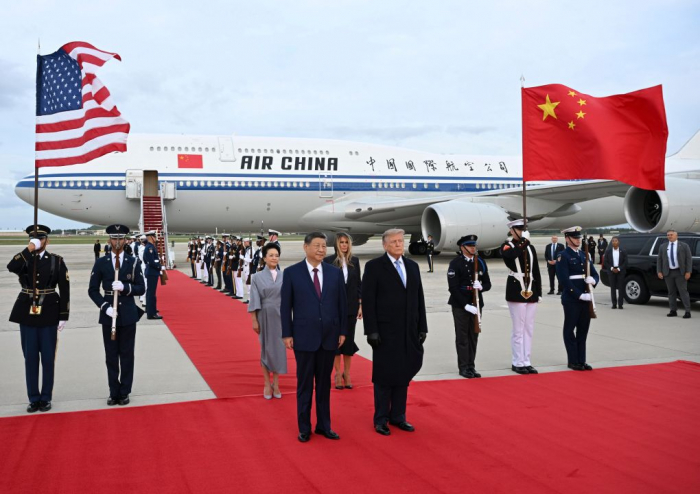
The state visit of President of the People’s Republic of China Xi Jinping to the United States from September 23 to 25, 2026, is one of the most significant events in international politics this year. Washington and Beijing are attempting to form a more predictable model of relations that allows for maintaining competition while simultaneously preventing it from escalating into open confrontation. Upon arriving in Washington, Xi Jinping stated that he is confident in the ability of China and the United States to find the right path of interaction in a new era. The Chinese leader outlined the desired models of relations, including cooperation, moderate competition, managed disagreements, and a commitment to peace.
This formula has not appeared for the first time. Its foundations were outlined during previous contacts between the leaders of the two states and received further development during the state visit of Donald Trump to China in May 2026. In the Chinese interpretation, the emerging approach assumes that cooperation must remain the most important component of the relationship, competition must be kept within certain limits, disagreements must remain manageable, and peace between the two powers must be preserved in the long term.
The current visit of Xi Jinping to the United States should be viewed as part of a more prolonged diplomatic process. PRC President Xi Jinping and US President Donald Trump have maintained contacts for over a year, including telephone conversations and a meeting in Busan, Republic of Korea, in October 2025. Top level contacts have become one of the important factors in stabilizing the relations between the two countries. The next important stage was the state visit of Donald Trump to China in May 2026. It demonstrated the desire of both states to transition from periodic crises and escalations to the search for a more sustainable model of interaction. It is precisely regular direct dialogue between the leaders that may set a strategic direction for the relations of the two largest powers and will not allow individual trade, technological, or political contradictions to escalate into a systemic crisis.
Beijing has voiced an interesting concept of transitioning from competition to the management of competition. The very fact of the emergence of such a formulation already speaks volumes. It is clear that Washington and Beijing are not going to abandon strategic rivalry. There are still numerous contradictions between them in the spheres of trade, technology, security, and geopolitics. However, current diplomatic activity shows that both sides are trying to create working mechanisms to keep these disagreements under control. In essence, no one is setting a goal to end the confrontation between the United States and China. The main task now is to channel this competition into certain frameworks and establish the rules of the game so that it does not overflow its banks.
Deep economic interdependence simply forces both countries to seek paths for dialogue. China and the United States remain the main economic centers of the planet, so any massive confrontation between them will hit not only themselves but also the entire global economy. A perfectly understandable logic follows from this. Both sides may continue to compete for markets, technologies, and influence, but at the same time, they are vitally interested in ensuring that this race does not destroy economic ties and does not escalate into an uncontrollable political conflict.
Beijing directly links the stability of bilateral relations with equality, mutual respect, and mutual benefit. The Chinese side is betting on expanding dialogue, constructively resolving disagreements, and developing real practical cooperation. Back in May, Xi Jinping emphasized that the trade and economic relations of the two countries are mutually beneficial by their very nature. Any emerging disputes must be resolved exclusively through equal consultations.
The political calendar of 2026 adds special weight to the dialogue between China and the United States. China is just beginning the implementation of the fifteenth five year plan for the period from 2026 to 2030. The United States is celebrating 250 years of its independence at the same time. Furthermore, China is hosting an informal meeting of APEC economic leaders, while the United States is holding a G20 summit. Both powers are entering a stage where their domestic economic tasks directly intersect with global interests. Both Beijing and Washington are interested in a certain predictability of the external environment, even if their views on the international order and national priorities often diverge. This is precisely why the stability of relations between these countries has significance that goes far beyond just China and America.
It is also symbolic what significance Washington has attached to the current visit of Xi Jinping. Donald Trump personally greeted Xi Jinping and his wife Peng Liyuan at Joint Base Andrews. The White House prepared a full state welcome ceremony involving American military personnel, the playing of national anthems, a military review, and a flyover by military aircraft. The visit program also includes a state dinner at the White House. Such a level of protocol in itself underscores the political significance of the meeting, regardless of the disagreements remaining between the parties.
A huge part of the global economy depends directly on how relations between Beijing and Washington develop. China and the United States remain the main global centers of production, consumption, technology, finance, and trade. Therefore, even a slight warming in their dialogue is immediately reflected in investment flows, technological chains, logistics, and global transport routes.
This is exactly why the interaction between China and the United States directly determines what the future global architecture will look like. At the same time, it is important not only how exactly Washington and Beijing will communicate. It is much more important what kind of international environment their interaction will create for all other countries. If the rivalry between the two powers follows the path of harsh confrontation, it will only accelerate the fragmentation of the global economy. This will complicate international trade, force the restructuring of production chains, and compel many countries to adapt to the increasing pressure from the two main centers of power. However, if the parties manage to build a model of managed competition, the space for independent economic policy of other states will, on the contrary, expand. A more predictable dialogue between Washington and Beijing will allow countries to freely cooperate with different economic centers. They will be able to develop trade, attract investments, and participate in global infrastructure projects without turning work with one partner into a mandatory rupture of ties with another.
For the South Caucasus, changes in relations between China and the United States have not only political but also very specific economic significance. The region occupies a strategic position on routes that connect Central Asia and China with European markets. As the traditional geography of global trade changes, the value of alternative transport routes between the East and the West only increases. For the South Caucasus, this may mean an increase in the importance of transport connectivity, further development of the Middle Corridor, and growing interest of major economic powers in the infrastructure of the region. At the same time, the states of the South Caucasus will have to build their own policies. They will have to balance between the expanding economic presence of China, relations with Europe and the United States, regional partners, and their own national interests.
Therefore, the negotiations in Washington should be viewed not only as another episode in the relations between China and the United States. In a broader sense, it is about the attempt of the two largest centers of power to define the rules of coexistence in a changing international system. Whether Washington and Beijing succeed in turning competition from a source of constant escalation into a manageable process will determine not only the nature of the relations between the two powers. It will also affect the space of opportunities for states located between the East and the West, including Central Asia and the South Caucasus.
Elbrus Mamedov

