
 Home
Three Powers, One World: What the Meeting in Shenzhen Revealed
-
 21 Nov 2026 10:54
-
 103
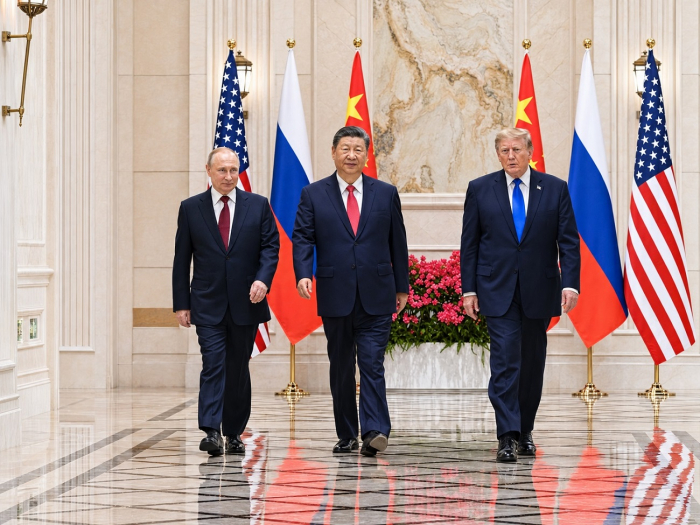
Whatever the immediate and long-term outcomes of the meeting between the leaders of Russia, the United States and China on the sidelines of the APEC summit in Shenzhen, it has already demonstrated, first, Beijing's exceptional influence and its growing role in shaping the international agenda and facilitating global dialogue. Second, the very fact that this dialogue took place can already be regarded as an important achievement. Moreover, the tone of the talks offers hope that they will continue. Perhaps Vladimir Putin best captured the overall mood of the participants when he summed up the meeting: “And it is better to have some agreements, even if they are not fully implemented, than to have none at all.” Xi Jinping, for his part, stressed that cooperation among major powers helps strengthen global security, whereas confrontation leads to chaos.
Putin, Trump and Xi Jinping adopted a document entitled the “Declaration of the Heads of State of Russia, China and the United States on Peace.” The parties expressed their commitment to reforming the United Nations, announced plans to increase the production and supply of refined petroleum products, noted that the International Criminal Court and other similar institutions should not abuse their powers, and reaffirmed that a nuclear war cannot be won and must never be fought.
The three countries thus agreed to discuss reducing nuclear risks and preventing the proliferation of nuclear weapons. This is a highly encouraging statement, especially considering that the New START Treaty between the United States and Russia expired in February of this year, leaving the world's two largest nuclear powers, for the first time in fifteen years, without an active bilateral agreement imposing legally binding quantitative limits on strategic offensive arms.
Against this backdrop, China's nuclear policy appears both understandable and reasonable: it has been steadily expanding its arsenal. According to estimates by the Federation of American Scientists (FAS), China's military stockpile reached approximately 620 nuclear warheads by 2026, and Beijing leads all other nuclear powers in the number of warheads produced annually. Some experts believe these figures underestimate China's capabilities and point out that the country has developed a fully fledged nuclear triad comprising bombers, submarines and ballistic missiles. According to some estimates, China's strategic arsenal is likely to exceed 1,000 warheads by 2030.
Notably, shortly before the trilateral meeting, Donald Trump stated in an interview with Fox News that the United States possessed approximately 4,000 nuclear weapons, while putting Russia's stockpile at 3,800 and China's at 400–500. These figures, incidentally, differ from those published by independent research organizations. The Federation of American Scientists, for example, estimates the military stockpiles of the United States, Russia and China at 3,700, 4,400 and 620 warheads, respectively. The Stockholm International Peace Research Institute (SIPRI) provides similar figures as of January 2026. It is also noted that the United States has 1,770 warheads deployed on delivery systems, compared with 1,796 for Russia.
The trilateral dialogue in Shenzhen should therefore be viewed in the context of a shift away from the former U.S.–Russian model of nuclear deterrence toward a more complex system in which China can no longer be ignored. Yet it remains unclear how this interaction will develop. Although the three largest nuclear powers have declared the need to prevent nuclear war, they have not yet proposed a concrete mechanism for limiting their arsenals. Could China join international agreements restricting the size of nuclear arsenals? Beijing seems to have a different vision: it has consistently emphasized that the use of nuclear weapons is unacceptable, even on a limited scale, and during the meeting Xi Jinping went so far as to propose the elimination of nuclear weapons altogether.
The declaration adopted in Shenzhen is therefore more of a political signal indicating a willingness to engage in dialogue than the actual beginning of a new nuclear disarmament agreement. Once again, however, what matters most is that the conversation took place at the highest level.
One regrettable omission from the final document is a separate provision addressing artificial intelligence and human control over nuclear systems. After all, advances in artificial intelligence are increasingly transforming military planning and the command of armed forces. AI can significantly accelerate the processing of intelligence, the analysis of potential threats, the operation of early-warning systems and the preparation of recommendations for military commanders. Machine-learning technologies are already being considered and used in various areas related to nuclear weapons systems, although the extent of their integration into nuclear command-and-control systems remains limited and insufficiently transparent. How much trust should be placed in AI in this field, and what decision-making authority, if any, should be delegated to it? These questions remain open. The danger is that an automated system could misinterpret information, mistake a false alarm for a real attack, or accelerate the escalation of a conflict to such an extent that human decision-makers would have too little time to verify a decision.
It is worth recalling that, at their meeting in Lima in November 2024, U.S. President Joe Biden and Chinese President Xi Jinping agreed on the need to maintain human control over decisions concerning the use of nuclear weapons. In September 2026, Donald Trump and Xi Jinping also agreed to establish a bilateral communication channel for exchanging information about AI-related incidents. Yet it is important to understand that political declarations, and even communication channels, are not enough to establish a fully functioning system of mutual restraints. What is needed are effective rules, notification mechanisms and procedures for verifying compliance.
This is precisely where the main problem arises: neither side is prepared to grant access to its nuclear command systems, which are among the most sensitive elements of national security. Without trust, transparency and agreed rules, even the most serious political declarations cannot guarantee that dangerous incidents will be prevented.
Regrettably, the danger of the United States using nuclear weapons did not disappear after the bombings of Hiroshima and Nagasaki. In the decades that followed, the possibility of their use was considered repeatedly during international crises and military conflicts, and it is still being seriously contemplated today. For this reason, setting aside the geopolitical context of the Shenzhen talks, it is no exaggeration to say that the entire world is looking to Russia, China and the United States with hope. They must continue their dialogue as a trio.
Irina Khalturina

