
 Home
HomeZhou Qian, Chinese Ambassador to Georgia: "China respects the sovereignty and the right of every country to independently determine its own foreign policy."
-
 01 Jul 2026 07:34
-
 508
508
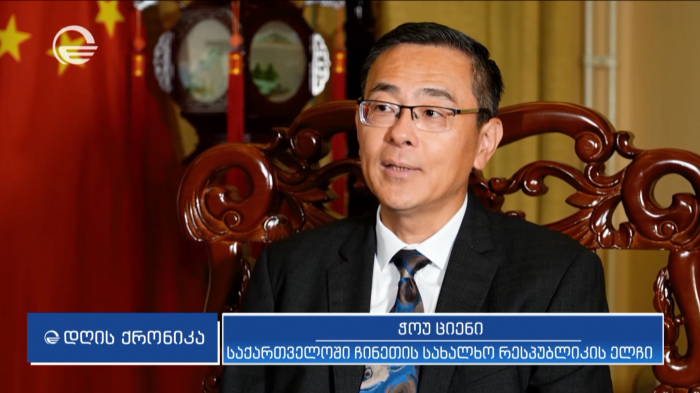
Chinese Ambassador to Georgia Zhou Qian gave an extensive interview to the Georgian TV channel Imedi where he detailed the Chinese vision for the further development of relations between Beijing and Tbilisi following the elevation of bilateral ties to a comprehensive strategic partnership. A significant part of the conversation was dedicated to the prospects of economic cooperation, the development of transport routes, investments, digital technologies, tourism, international political issues, and the place of Georgia in the modern architecture of Eurasia.
The Ambassador emphasized that the decision by the leaders of the two states to elevate relations to a comprehensive strategic partnership has become an important historical milestone and reflects a high level of mutual trust between China and Georgia. According to him, the new status should not remain merely a political declaration but implies a transition to large scale practical cooperation in virtually all areas. China expects to significantly intensify high level political dialogue, expand the exchange of experience in public administration, and strengthen coordination between the Chinese Belt and Road Initiative and the development of the Middle Corridor. Since Georgia occupies a strategic position between Europe and Asia and China possesses significant experience in building modern infrastructure, cooperation in the field of highways, railway lines, ports, and airports is considered one of the key areas of interaction.
The diplomat paid great attention to trade issues. He noted that following the update of the free trade agreement between the two countries, additional opportunities are opening up for exporting Georgian products to the Chinese market. In China, they expect an increase in the supply of Georgian wine, mineral water, spices, nuts, and other agricultural products. At the same time, Chinese manufacturers plan to more actively promote modern electric vehicles, household appliances, and high tech products in the Georgian market. The Ambassador also drew attention to the expansion of cooperation in the financial sector and the digital economy, reminding about the acquisition of Liberty Bank by Basisbank, which is controlled by Chinese capital. In addition, according to him, Chinese ecommerce platforms are gradually starting to operate in the Georgian market, which should give an additional impetus to the development of bilateral trade.
Separately, Zhou Qian focused on the prospects of humanitarian contacts. He noted that a mutual visa free regime is already in effect between the two countries, direct flights have been opened, and the number of contacts between citizens is constantly increasing. China is interested in further expanding air communication, developing educational cooperation, and increasing the number of Georgian students studying at Chinese universities. Of particular importance, according to him, is the already signed agreement on the mutual recognition of higher education diplomas, which opens up new opportunities for the youth of both countries. China also intends to support the teaching of the Chinese language in Georgia and promote the strengthening of cultural ties between the peoples.
Speaking about trade cooperation, the Ambassador noted that currently a significant part of Georgian exports to China consists of precious metal ores and transit supplies. At the same time, he believes that it is agriculture that can become one of the most promising areas of cooperation. China offers Georgia to participate more actively in the largest international exhibitions held in the PRC to make Georgian goods more recognizable among Chinese consumers. According to the diplomat, the development of ecommerce will become an additional incentive. He announced that the parties are considering the possibility of signing a separate memorandum of cooperation in this field and also plan to organize training events for Georgian producers on the use of Chinese internet platforms.
A special place in the interview was given to the topic of modernizing Georgian agriculture. The Ambassador noted that the natural conditions of Georgia allow for a significant increase in the production of high value added products. China is ready to offer cooperation in the field of modern technologies in crop production, animal husbandry, fishing, the development of agricultural infrastructure, and product processing. In his opinion, increasing the depth of processing of fruits, nuts, and other agricultural products will significantly increase the competitiveness of Georgian exports in international markets.
A separate block of the interview was dedicated to the Middle Corridor. The Chinese diplomat emphasized that the ongoing changes in global logistics make the Trans Caspian route increasingly in demand. According to him, the political stability of the countries located along the route, as well as the need to diversify transport routes after the emergence of problems in other directions, significantly increase the importance of the Middle Corridor. At the same time, he acknowledged that in terms of transportation costs, cargo delivery speed, and the level of infrastructure development, this route still lags behind the northern railway route between China and Europe. Therefore, China expects further modernization of the transport infrastructure of Georgia, unification of the regulatory framework, digitalization of transportation, and expansion of joint investments in the transport industry.
Zhou Qian attaches great importance to the launch of direct air communication between Shanghai and Tbilisi. He believes that the new route will become not only a passenger but also a full fledged cargo transport channel that will significantly strengthen business ties between the two countries. According to him, Shanghai is the largest financial and trade center of China, as well as the leading international exhibition platform of the country. Thanks to direct air communication, business representatives from the most economically developed regions of China will be able to visit Georgia more often. At the same time, the diplomat recommended that the Georgian authorities more actively adapt the tourism infrastructure for Chinese guests, including the placement of information in the Chinese language at airports and the development of modern aviation infrastructure. He positively assessed the plans for the construction of a new international airport and the expansion of the existing Tbilisi airport, emphasizing the readiness of China to participate in such infrastructure projects.
Speaking about tourism, the Ambassador noted that Georgia possesses unique natural, historical, and cultural advantages. According to his data, over the past year the country was visited by about 128 thousand Chinese tourists, which significantly exceeds the figures of the previous period. He believes that the potential for further growth remains very high. Additional interest from the Chinese audience was caused by the participation of Georgia in the international tourism exhibition ITB China, after which the number of publications about Georgian cuisine, wine, and national culture significantly increased in Chinese social networks. China intends to continue cooperation with Georgian tourism organizations, organize educational programs for industry specialists, and promote the development of new tourism products.
A significant part of the interview was dedicated to high tech issues. The Ambassador spoke in detail about the achievements of China in the field of artificial intelligence, the digital economy, high tech manufacturing, aviation, biomedicine, and quantum technologies. According to him, China has already become one of the world leaders in these areas. He noted that the Georgian government also sets itself the task of turning the country into a regional digital hub and data center. That is why the parties have already signed memoranda of cooperation in the field of the digital economy and artificial intelligence. Chinese companies are considering the possibility of organizing student exchange programs, as well as implementing joint projects in the field of artificial intelligence, big data, fintech, digitalization of agriculture, and smart cities. At the same time, China intends to adhere to a policy of open technology exchange, including the use of open source artificial intelligence models.
Answering questions about the foreign policy balance of Georgia, Zhou Qian stated that the development of relations with China does not contradict the cooperation of Georgia with the European Union and Western countries. He emphasized that China respects the sovereignty, territorial integrity, and the right of each country to independently determine its own foreign policy. According to him, Georgia simultaneously has free trade agreements with both the European Union and China, so it is the maintenance of active ties with both directions that corresponds to the national interests of the country. China, according to his assertion, has never interfered in the internal affairs of Georgia, imposed its own political model on it, or demanded a choice between the East and the West.
Commenting on the concerns widespread in the West regarding the possible dependence of Georgia on China, the diplomat rejected such assessments. He stated that the cooperation between the two countries is built exclusively on the principles of mutual benefit and respect. According to him, China has never linked economic cooperation with political demands and does not seek to limit the independence of its partners. He also noted that the governments of the two countries actively exchange experience on various issues of public administration, however, such interaction is not associated with the imposition of political decisions. The Ambassador called the claims that the development of cooperation with China could lead to the political dependence of Georgia unfounded.
In the final part of the interview, Zhou Qian focused in detail on the issues of global politics. He presented the main provisions of the White Paper on the Reform of Global Governance published by China. According to him, the modern world is experiencing a period of deep upheavals, and the existing system of international relations needs to be updated. China advocates for strengthening the role of the United Nations, compliance with international law, the development of multilateral cooperation, and enhancing the role of the Global South countries. Among the main priorities, Beijing calls for respect for the sovereignty of states, the political settlement of conflicts through dialogue, the preservation of open world trade, the expansion of the participation of developing countries in making international decisions, and the improvement of global governance mechanisms in new areas, including space and artificial intelligence. According to the Ambassador, the transition of Georgian Chinese relations to the level of a comprehensive strategic partnership will create additional opportunities for the interaction of the two states in international political issues as well.
GSR
The full text of the interview is available via the official link.
https://ge.china-embassy.gov.cn/eng/xwdt/202606/t20260629_11953870.htm?fbclid=IwY2xjawSu7DFleHRuA2FlbQIxMABicmlkETFKeW5NNmlBMU1kWUN1RUlNc3J0YwZhcHBfaWQQMjIyMDM5MTc4ODIwMDg5MgABHvNI1nzXJinVWXev-y3W-doEGTci695k2zIgVHDS1xK_gyJqLxWwshi5kid7_aem_wOmqleM9-3cC60Q7n50hyg

