
 Home
HomeThe Third Attempt: Why the Anaklia Port is Destined for Success This Time
-
 31 Jul 2026 12:27
-
 286
286
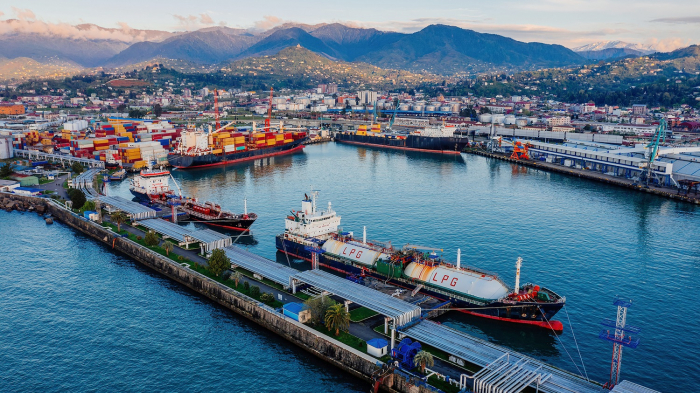
During a press conference on July 6, Georgian Minister of Economy Mariam Kvrivishvili announced a significant change in the concept for the construction of the Anaklia deep-sea port. According to her, a fundamental decision has been made to keep the facility in full state ownership, with the state holding 100% of the port's shares; no sale to private or foreign investors is envisaged. Thus, the Georgian authorities have outlined a new project implementation model where strategic infrastructure remains under full state control, and the participation of foreign partners will be limited to the operation of individual terminals. International companies will be able to participate in the management of terminal infrastructure exclusively on the basis of lease agreements, without acquiring any ownership rights to the port itself.
As the Minister explained, the government is launching an open process to attract strategic partners, which could include both state entities and private companies possessing experience in port infrastructure management, their own cargo flows or the ability to attract them, as well as the necessary financial resources for developing terminal equipment and ensuring efficient port operations. It was noted that several Western countries and international companies have already expressed interest in participating in the project. However, specific potential partners are not being named yet, as the negotiation process is ongoing.
In effect, the new model implies a separation of ownership and operational functions, under which the state retains full control over the strategic facility, while international operators can engage in commercial activities through long-term leases and management of individual terminals. According to the Georgian authorities, this approach will simultaneously ensure national control over the port and attract foreign expertise, investments, and additional cargo flows.
The Minister also noted that the government intends to more actively attract investors from China, Central Asian states, Azerbaijan, and other countries involved in the development of the Middle Corridor. It was noted that construction parameters will be revised, as the growth in cargo traffic along the Trans-Caspian route allows for an increase in the initial capacity of the future port. According to government plans, the first ship is expected to call at the Anaklia port in 2029.
This means that Tbilisi is radically changing its approach to attracting foreign capital into strategic infrastructure. The new concept for the port sector's development effectively nullifies the ambitious plans of 2024. Previously, the Georgian authorities planned to sell 49% of the shares of the key asset to a specialized consortium. The only participant in the tender at that time was a consortium comprising China Communications Construction Company and China Harbour Investment. Under the previous model, the state would have held 51% of the shares, and China Communications Construction Company (CCCC) — 49%.
It was precisely this factor that drew heightened international attention to the project. Since China Communications Construction Company is under US sanctions, its participation in one of the largest infrastructure projects in the South Caucasus became a subject of active discussion among Georgia's Western partners. At the same time, many experts pointed out that this is one of the world's largest Chinese infrastructure corporations, having implemented dozens of large-scale port and transport projects worldwide, and the debate around Anaklia largely reflected the broader context of intensifying strategic competition between the world's major centers of power.
Subsequently, despite numerous rounds of negotiations and regular statements by officials about the imminent success of the deal, the final document was never signed. The Georgian Minister of Economy later explained this reversal as being driven by concern for national interests. However, the authorities did not disclose the specific reasons and details of the revised agreements. At the same time, Tbilisi is signaling that it does not intend to completely scale back cooperation with China. The Georgian side, as before, is counting on Chinese investments and technologies, but in a fundamentally different format. The updated model completely excludes the alienation of ownership rights to the port itself. Foreign partners will be offered only operational management of individual terminals. Such a compromise allows Georgia to maintain full sovereignty over the strategic facility while avoiding toxicity in its relations with Western countries.
Azerbaijan could become one of the key beneficiaries of the project under the new Anaklia development model. It is precisely through Azerbaijani ports on the Caspian Sea, railway infrastructure, and transport and logistics companies that the bulk of the Middle Corridor cargo flows pass, moving from Central Asia towards the South Caucasus and Europe. The development of the Anaklia deep-sea port will significantly expand the export and transit capabilities of the entire Trans-Caspian route, reduce dependence on existing Black Sea ports, enhance the resilience of logistics chains, and create additional capacity for handling growing freight volumes. It is no coincidence that Baku has been consistently investing in the development of the Baku International Sea Trade Port, the Baku-Tbilisi-Kars railway, and other transport infrastructure facilities. In this context, the potential participation of Azerbaijani state structures, port operators, logistics companies, or investment funds in the operation of individual Anaklia terminals fully aligns with Azerbaijan's strategic interests in further strengthening the Middle Corridor and creating a unified transport and logistics space in the South Caucasus.
Tbilisi is also radically revising the financial architecture of the project. The total investment volume remains at $1.1 billion, but the state's role in financing the construction is increasing manifold. The government will need to mobilize an additional $200 million to build berths, utility networks, and basic port infrastructure. Previously, these costs were to be borne by the private investor. The new funds are planned to be raised from the state budget and through cooperation with international financial institutions. The authorities also reported optimizing costs by about $50 million, which allowed them to reduce the initial additional requirement from $250 million to $200 million.
The updated model has provoked a mixed reaction within Georgian society. Opposition politicians are convinced that the main problem lies not in the choice of an organizational scheme, but in the years-long delays in implementing the initiative. According to critics of the authorities, the constant changing of models merely masks the lack of practical results.
The new concept has also drawn critical assessments from a number of representatives of Georgia's expert community. In particular, it was noted that abandoning the initial model, which was based on a significant volume of foreign direct investment, increases the financial burden on the state. According to experts, under this approach, the government will have to independently ensure the attraction of additional budgetary and credit resources to implement the project. Experts also point to the need to ensure maximum transparency in the selection of terminal operators, public procurement, and the determination of funding sources.
Representatives of the ruling team view the new model as an opportunity to expand the pool of potential international partners and make the project more flexible in terms of attracting terminal infrastructure operators. In their view, maintaining full state control over the strategic facility while simultaneously involving international companies in terminal operations will strengthen the role of the Anaklia port in the development of the Middle Corridor and increase its attractiveness for global cargo flows.
Separate attention in the expert discussion is paid to the issue of potential participation by foreign contractors, including companies from China. At the same time, emphasis is placed on the importance of ensuring that the selection of partners is carried out on the basis of transparent procedures that align with Georgia's national interests and international corporate governance standards. Analysts also note that the so-called "landlord model," which involves the state retaining ownership of port infrastructure while transferring terminals to specialized operators for long-term management, is successfully used in many countries around the world. At the same time, according to their assessment, the effectiveness of such a model largely depends on the presence of an independent port administration, a transparent system of concession agreements, and a clear delineation of powers between the state and commercial operators.
The Anaklia deep-sea port is rightfully considered one of the most large-scale infrastructure projects in modern Georgia. Its construction is viewed as a fundamental element in enhancing the country's transit potential along the Middle Corridor route, which connects Europe and Asia via the South Caucasus and the Caspian Sea. Well, the history of this initiative's implementation is full of dramatic twists. Initially, in 2016, construction was entrusted to the Anaklia Development Consortium, with plans to receive the first ship as early as 2020. However, the contract was terminated. The parties exchanged mutual claims, and Georgia ultimately won two international arbitration proceedings. The situation changed radically following the active development of the Middle Corridor. Studies commissioned by the European Commission rank the port among strategically important facilities.
At the same time, analysts note that the development of Eurasian transport connectivity is accompanied by the formation of several complementary international routes, each striving to carve out its own niche in global logistics. Under these conditions, the timely integration of the Anaklia port into existing Eurasian transport initiatives, including projects implemented within the framework of the Middle Corridor countries' cooperation and the Belt and Road Initiative, is of particular importance for Georgia. It is the ability to ensure effective cooperation with key regional partners that will largely determine Anaklia's future role in the international transport system. Thus, the deep-sea port project is increasingly transcending the boundaries of a purely infrastructure task, becoming an important element of Georgia's long-term geo-economic strategy, as well as one of the key projects capable of influencing the strengthening of the South Caucasus's role in the emerging architecture of Eurasian transport connectivity.
Elbrus Mamedov

