
 Home
HomeWhile the world looks the other way, a new Eurasia is being born
-
 17 Jul 2026 16:05
-
 442
442
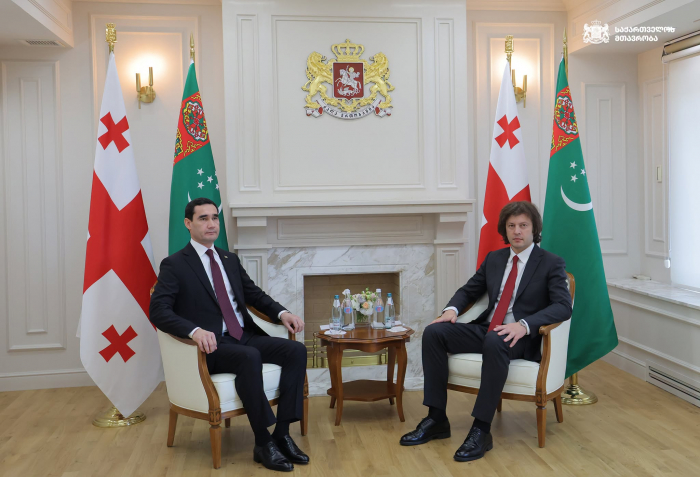
On July 16, the President of Turkmenistan, Serdar Berdimuhamedov, visited Georgia on an official trip. An official welcoming ceremony for the Turkmen leader, who arrived on his first state visit to the country, was held at the presidential palace in Georgia. During the negotiations, the parties discussed prospects for expanding bilateral cooperation, paying special attention to the development of trade and economic ties, attracting investments, and interaction in energy, transport, and logistics. One of the central themes of the meeting was the more effective use of the strategic potential of the Middle Corridor. The Georgian side confirmed its interest in the further development of transit cooperation between Europe and Asia, including the use of the capabilities of the country's Black Sea ports and the future deepwater port of Anaklia, which is considered one of the key infrastructure projects in the region. Also in Tbilisi, negotiations took place between the Georgian Prime Minister Irakli Kobakhidze and the Turkmen President Serdar Berdimuhamedov in an expanded format with the participation of members of the government delegations of both countries. The main focus was placed on the further development of bilateral cooperation, the expansion of economic ties, and the strengthening of partnership in the transport and logistics sphere. During the talks, the parties discussed a wide range of interaction issues, emphasizing the importance of intensifying trade and economic cooperation and making fuller use of the existing potential. A special role in the development of practical interaction was assigned to the Joint Intergovernmental Commission of Georgia and Turkmenistan, which is considered a key mechanism for the implementation of joint projects. Separate attention was paid to transport and transit cooperation. The leaders of the two countries confirmed their interest in the further development of the Middle Corridor as one of the most important routes connecting Europe and Asia, and also expressed their readiness to deepen the partnership in the sphere of international logistics and transit. Representatives of the relevant agencies of the two states signed a package of memorandums of understanding providing for the development of cooperation in the financial, economic, and transport spheres, as well as in the fields of healthcare, education, and culture.
This trip became a logical continuation of the state visit of the Turkmen leader to the Republic of Azerbaijan, which took place on June 22, 2026. A month earlier, the leaders discussed key issues of the global agenda, including transport and energy security. An agreement was reached to hold a senior level meeting of the Caspian states on Caspian Sea issues in October 2026 in the Avaza National Tourist Zone. Special attention was paid to the development of international transport corridors. The leaders confirmed their support for the initiative to create a transport corridor from the Caspian Sea to the Black Sea along the route through Turkmenistan, Azerbaijan, and Georgia to Romania, and also noted successful cooperation within the corridor from Afghanistan through Turkmenistan and Azerbaijan to Georgia and Turkey. In addition, Turkmenistan confirmed its readiness for partnership in electric power engineering, including electricity supplies and the construction of a new power plant with a capacity of 1574 megawatts on the Caspian coast, as well as in the oil and gas, chemical, and textile industries.
It is obvious that in the context of the global restructuring of trade routes and energy alliances on the continent, a new center of gravity is quietly but confidently forming. Turkmenistan, Azerbaijan, and Georgia form one of the key geoeconomic triangles of Eurasia. This space accounts for one of the largest energy potentials in the world, including Turkmen natural gas reserves, the transport system of the South Caucasus, and the emerging Middle Corridor, which is already capable of becoming one of the main Eurasian transport arteries in the coming years. This alliance has ceased to be just a set of bilateral agreements and has turned into a complete alternative architecture of regional interaction, where each country performs its unique role. Turkmenistan acts as a source of energy resources and an entry point for Central Asian goods, Azerbaijan takes on the function of a critically important transit hub redistributing flows between the Caspian and Black Seas, and Georgia provides direct access to European markets through its ports and transport infrastructure. Together they create a continuous value chain that allows goods, energy, and capital to move from the banks of the Amu Darya to Brussels. This triangle does not just connect geographical points on a map, but it forms a new economic reality where sovereignty and independence from external routes become the main competitive advantages in an era of global transformation.
Energy and transport are becoming two complementary directions of integration for Turkmenistan, Azerbaijan, and Georgia, creating a solid foundation for an enduring strategic partnership of the three states. These two spheres do not exist in isolation but form a single technological and economic circuit where one direction inevitably strengthens the other. Gas flows and prospective green energy supplies require reliable physical infrastructure, and the active development of ports and railway lines, in turn, guarantees stable supplies of these energy resources. When Azerbaijan organizes gas swaps or expands the capacity of the Southern Gas Corridor, it relies directly on the growing logistics capabilities of the entire region. When Georgia accepts transit cargo from Central Asia, it simultaneously strengthens its role as an indispensable energy and transport bridge to Europe. Investments in such projects are measured in tens of billions of dollars and are designed for many decades, making this cooperation not a situational reaction to current global crises but a fundamental structural choice.
Energy here works as the circulatory system of the entire alliance. The gas sector remains in the spotlight, where the ambitions of the three countries rely on a colossal resource base. The Transcaspian gas pipeline, with a design capacity of 30 billion cubic meters of gas per year, is capable of becoming the largest new route for exporting Turkmen gas to Europe. The project involves the construction of an approximately 300 kilometer sea section between Turkmenbashi and Baku, and its export potential is estimated at 10 to 12 billion cubic meters of gas annually for the European market. This ambitious project opens a direct road for the colossal resources of the Galkynysh field, which is the second largest in the world. For the European market, which is persistently seeking reliable alternatives to traditional suppliers, such a volume means a real opportunity to diversify energy security. The Southern Gas Corridor itself has already created ready infrastructure. Its total length is about 3500 kilometers, connecting the Caspian Sea with Italy, and the total volume of investments has already exceeded 35 billion dollars, making it one of the largest energy projects in Eurasia. Turkmenistan is considered a key partner for diversifying these supplies to the European Union. The implementation of this initiative will require delicate diplomacy, but the potential benefit makes this project a true geopolitical priority. An important step was the signing in January 2021 of an agreement between Azerbaijan and Turkmenistan on the joint development of the Dostluk field, which significantly reduced the political risks of further energy cooperation in the Caspian Sea.
While massive infrastructure projects await their time, the countries are using flexible and pragmatic schemes. Gas swap mechanisms through the territory of Iran have already become a practical tool for energy cooperation. In 2025, the volume of such exchange will reach about 1.3 billion cubic meters of gas, confirming the practical viability of the model before the launch of the complete Transcaspian route. Turkey has already begun receiving Turkmen gas through similar barter agreements with Tehran. This development serves as a transitional stage to direct supplies, the resumption of which is planned after 2026. But the future of this alliance lies not only in hydrocarbons. The next stage of integration is the development of the Caspian green energy corridor. The project involves using the huge potential of wind and solar generation in the Caspian region with the subsequent transmission of electricity through Azerbaijan and Georgia into the European energy system. Using this potential turns the region from a raw material appendage into a true outpost of the European climate agenda.
If energy is the blood of the alliance, then transport is its arteries. The Middle Corridor, officially named the Transcaspian International Transport Route, is gradually turning into the main alternative to northern cargo routes between Asia and Europe, demonstrating truly explosive growth. In 2024 alone, the cargo turnover of the route reached 4.1 million tons, increasing by 63 percent compared to the previous year. Over the year, more than 210 container trains were organized, transporting over 420,000 tons of container cargo.
The numbers speak for themselves and paint a picture of inevitable logistics transformation. With a total route length of about 7000 kilometers, cargo delivery between China and Europe takes only 20 to 25 days, while the potential throughput capacity of the corridor is estimated at 25 to 50 million tons annually. For example, the expansion of the Kazakh section between Dostyk and Moyinty increases its throughput capacity to exactly 50 million tons. According to World Bank forecasts, by 2030 cargo turnover could reach 11 million tons, and the volume of mutual trade among the countries of the region could increase by almost 37 percent.
Priority spheres are becoming not only energy but also industry, finance, and joint logistics hubs. For Turkmenistan, the development of the western direction means diversifying gas exports, reducing dependence on individual markets, and reaching European consumers. The European Union views this route simultaneously as a transport, energy, and climate project capable of increasing the resilience of the European economy and ensuring the diversification of gas sources bypassing sanction regimes.
Despite general optimism, the path of the alliance is strewn with serious challenges. The main obstacles remain the need for massive infrastructure investments, environmental requirements, legal issues regarding the status of the Caspian Sea, and geopolitical competition from major regional players. The throughput capacity of ports and railway branches requires colossal investments to reach target indicators. Geopolitical friction has not disappeared either. And here China naturally and organically enters the stage. The Belt and Road Initiative, which Beijing has been promoting for over a decade, finds an ideal partner in this triangle. The Middle Corridor is not just an alternative but an insurance policy for Chinese exports, as well as for Central Asian and South Caucasian countries, to Europe, diversifying risks and creating a new trade arm that connects the Middle Kingdom with the markets of Central Asia, the Caucasus, and further through the Black Sea to Europe. For China, participation in this project is not geopolitical expansion but pragmatic logistics. Beijing has long understood that one route means vulnerability, while several routes mean resilience.
The emerging alliance of Turkmenistan, Azerbaijan, and Georgia is gradually turning into one of the most important elements of the new architecture of Eurasian energy, logistics, and economic security. Today, the three states are united not only by geography but also by specific economic indicators. Trade turnover between Turkmenistan and Azerbaijan is about 400 million dollars. Based on the results of 2026, mutual trade turnover between Turkmenistan and Georgia is projected at the level of 105 to 115 million US dollars, which will record a confident growth of more than 25 percent compared to the baseline figure of 80 million dollars. The Middle Corridor already transports 4.1 million tons of cargo annually. The Southern Gas Corridor, costing 35 billion dollars, functions as a ready energy highway, and the prospective Transcaspian gas pipeline with a capacity of 30 billion cubic meters per year is capable of finally integrating Central Asia into the European energy system. Based on the results of the Middle Corridor operations, it was recorded that transit cargo flow between the ports of Baku and Turkmenbashi already showed growth of approximately 15 percent at the beginning of the year, which directly converts into increased revenues from transport services within the overall economic balance. Although these figures do not yet look like macroeconomic giants, their structure shows that the countries are moving from simple transit to creating added value. It is precisely the combination of these figures that demonstrates that we are no longer talking about a concept of the distant future but about the formation of a new architecture of Eurasia, where this region becomes the main geopolitical bridge of the 21st century.
GSR

