
 Home
HomeThe Port of Anaklia Holds an Important Place in China's Strategy
-
 17 Jun 2026 11:24
-
 626
626
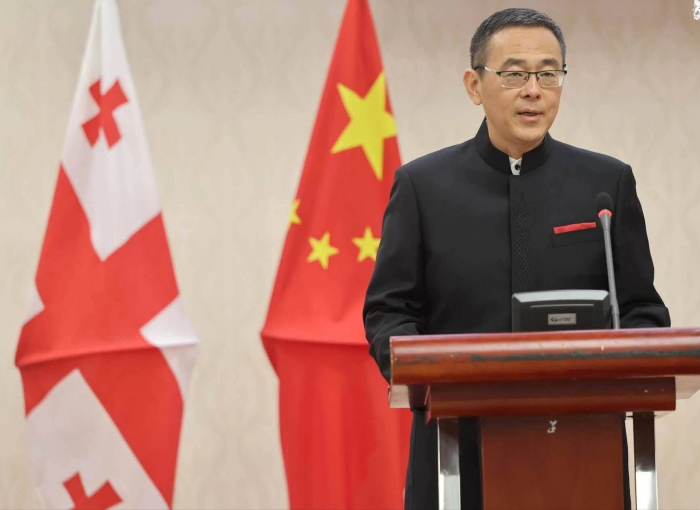
On June 5, 2026, the Ambassador of the People's Republic of China to Georgia, Zhou Qian, gave an extensive interview to Malkhaz Gulashvili, head of the "Georgian Time" media holding and host of the "Real Politics" program. The interview, which aired on June 12, is of particular interest not only as an overview of the current state of Sino-Georgian relations but also as an articulation of Beijing's strategic vision regarding Georgia's role in modern Eurasia.
The interview with the Chinese Ambassador to Georgia has effectively served as a programmatic statement of how Beijing views Georgia, the South Caucasus, and the prospects for Eurasian integration today. The core message is that relations between China and Georgia have reached a qualitatively new level following the establishment of a strategic partnership in 2023, now encompassing not only trade but also infrastructure, energy, the digital economy, technology, transport, and international diplomacy.
Special attention in the interview is paid to Georgia's role as a key hub between Europe and Asia. China views the country not as a peripheral partner, but as a vital link in modern Eurasian connectivity. This is precisely why great importance is attached to the development of the Middle Corridor, which, amid the instability of traditional routes through Russia, Ukraine, and the Middle East, is becoming one of the most promising transport corridors between China and Europe. According to the Chinese side, thanks to its geographical location, Georgia has the potential to become one of the major logistics hubs in Eurasia.
A significant part of the interview is dedicated to the Belt and Road Initiative. The Ambassador emphasizes that Georgia's participation in this project has already yielded tangible results for the country in the form of modernized highways, railways, and other transport infrastructure. China considers the further alignment of the Middle Corridor with the Belt and Road Initiative to be one of the main priorities for future cooperation.
The most crucial part of the interview for Georgia's future was the topic of the Anaklia Port. The Chinese diplomat explicitly named Anaklia an important component of the Middle Corridor, emphasizing that this project can enhance the resilience of logistics and industrial supply chains across Eurasia. In the Chinese vision, Anaklia is not just a new Georgian port on the Black Sea. It is an infrastructure project of international significance that will improve the efficiency of cargo flows between China, Central Asia, the South Caucasus, and Europe.
Particularly noteworthy is the statement regarding the readiness of Chinese companies to participate in the port's construction on a commercial basis. This indicates that Beijing is closely monitoring the project's development and views it as a potential element of its own Eurasian logistics strategy. The Ambassador specifically noted his satisfaction that dredging operations and breakwater construction have already begun in Anaklia. The Chinese side expressed hope for the project's completion as swiftly as possible, as its commissioning will transform Georgia into a more reliable and competitive transport hub between Europe and Asia.
In effect, the interview implies that Beijing views Anaklia as one of the most promising infrastructure projects in the South Caucasus. For China, the new deep-water port is a crucial element in diversifying freight routes to Europe. The more alternative routes that exist between Asia and Europe, the more resilient global supply chains become. That is precisely why the Chinese side directly links the development of Anaklia to issues of economic security and the stability of international trade.
Beyond the transport sector, China sees great prospects for cooperation with Georgia in energy. The interview details the country's hydropower, wind, and solar potential. Chinese companies are ready to participate in the construction of power plants, substations, and power transmission lines. In effect, Beijing is offering Georgia the use of Chinese technologies to achieve energy self-sufficiency and transform the country into a regional energy hub.
Agricultural trade is highlighted as another important area. The Chinese market is already open to Georgian wine and mineral water, and following the signing of relevant protocols, prospects are opening up for the supply of Georgian honey and poultry products. China also proposes cooperation in the field of modern agricultural technologies and irrigation systems.
The digital economy occupies a prominent place in the interview. China supports Georgia's aspiration to become a digital hub for Eurasia and offers cooperation in artificial intelligence, 5G, data centers, fintech, and smart cities. Memorandums of cooperation in the digital economy and artificial intelligence have already been signed, laying the groundwork for long-term projects.
Separate emphasis is placed on the significance of the recently upgraded free trade agreement between China and Georgia. It includes new provisions on investment protection and enhancing the transparency of investment activities. China expects that this will substantially increase the volume of direct investment between the two countries.
In the political part of the interview, Beijing reaffirms its support for Georgia's territorial integrity and positively assesses Tbilisi's course toward peaceful conflict resolution. China also positions itself as a proponent of diplomatic methods for resolving international crises and emphasizes its role in mediation efforts in the Middle East and other regions of the world.
Overall, the interview demonstrates that China views Georgia as one of the key partners in the South Caucasus. Beijing sees the main areas of cooperation as the development of the Middle Corridor, the construction of the Anaklia Port, the modernization of transport infrastructure, energy, digital technologies, agriculture, and the expansion of bilateral trade. At the same time, it is the topic of Anaklia that holds a special place in the Chinese vision of the region's future. For China, this port is not just a Georgian national project, but a vital element of the emerging architecture of Eurasian logistics, capable of strengthening Georgia's position as a strategic bridge between Europe and Asia.
GSR
The full interview can be read at the following link:
https://ge.china-embassy.gov.cn/eng/xwdt/202606/t20260614_11944345.htm?fbclid=IwY2xjawScr2pleHRuA2FlbQIxMQBzcnRjBmFwcF9pZBAyMjIwMzkxNzg4MjAwODkyAAEeD6QWOwesqtylYBjM4jne6qnUdr44b9silrxPpl6X6-vRqqDfvyHrLrtKrCs_aem_NY4JjEyAGsp9F-1u5lxfAQ

