
 Home
HomeChina and the UK: Between Pragmatism and Bloc Logic
-
 30 Jan 2026 08:02
-
 332
332
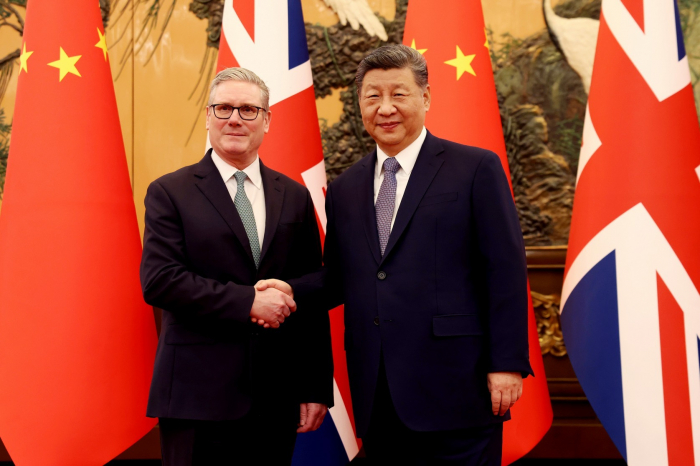
Keir Starmer, the UK Prime Minister, arrived in Beijing on Wednesday for an official visit to China, which is scheduled to last from Wednesday to Saturday. This visit signifies the first occasion of its kind in eight years, with the previous visit by a British prime minister occurring eight years prior.
During his visit to China, Keir Starmer had the privilege of meeting with several high-ranking Chinese officials, including the Chinese President, Xi Jinping; the Premier of the State Council, Li Qiang; and the Chairman of the Standing Committee of the National People's Congress, Zhao Leji. A profound exchange of perspectives was conducted by the two parties on the subject of bilateral relations, in addition to a comprehensive range of subjects of mutual interest. In addition to his scheduled visit to Beijing, the British Prime Minister will also visit Shanghai as part of his official visit. Since assuming office, the British Labour government has made the establishment of a coherent, robust, and strategic relationship with China a central tenet of its foreign policy agenda. This commitment is evidenced by the government's proactive promotion of dialogue and cooperation between the two nations. Keir Starmer is at the head of a prominent delegation, which includes high-ranking executives from over 50 significant British companies, in addition to representatives of British government and public institutions. The delegation is constituted of representatives from key sectors of the UK economy, including finance, healthcare, manufacturing, and the cultural and creative industries. On Wednesday, a significant number of British companies articulated a positive outlook on the Chinese economy's long-term prospects. Furthermore, these companies reaffirmed their commitment to persist in their investment activities within the Chinese market.
It is estimated that by 2025, the value of trade in goods between China and the UK will reach $103.7 billion, trade in services is expected to exceed $30 billion, and the bilateral investment fund will approach $68 billion. The Chinese Ministry of Commerce has asserted that the ongoing cooperation between the two nations is both pragmatic and resilient.
In the course of his meeting with British Prime Minister Keir Starmer, Chinese President Xi Jinping made the following statement: "China will never pose a threat to other countries, no matter how the country grows and develops." Xi Jinping emphasised that China is committed to peaceful development, has never initiated warfare, and has never occupied the land of another nation. The Chinese President made an appeal to China and the UK, as proponents of multilateralism and free trade, to collectively uphold and implement genuine multilateralism, emphasising that international law is only genuinely efficacious when all nations adhere to its principles. During a meeting with British Prime Minister Keir Starmer in Beijing, the Chinese President also called for expanded mutually beneficial cooperation with the UK in education, healthcare, finance, and services. The necessity of particular focus on domains such as artificial intelligence, life sciences, new energy, and low-carbon technologies was underscored, with the objective of facilitating collective advancement and shared prosperity. The People's Republic of China is also willing to give due consideration to the possibility of introducing a unilateral visa-free regime for citizens of the United Kingdom. Xi Jinping emphasised the importance of strengthening people-to-people ties and the consistent promotion of people-to-people contacts. The meeting between Chinese President Xi Jinping and British Prime Minister Keir Starmer in Beijing is not a formal meeting, but a symbolic one, reflecting both sides' desire to clarify their approaches to bilateral relations and the global agenda in the context of a changing international environment, particularly in light of the signals and discussions voiced at the World Economic Forum in Davos.
The UK is in the process of reformulating its foreign policy following a change in government. The Starmer cabinet is seeking to restore governance in international relations and reduce the costs of the hardline confrontational line of recent years, particularly the last six months, while maintaining coordination with the US. Contact with Beijing is a positive signal of a shift from ideological rhetoric to a more pragmatic dialogue. For China, it is currently important to reduce tensions in relations with the West and expand space for dialogue. In this sense, Beijing views the UK as a partner with whom such a conversation is possible. The UK has strong global financial interests and close ties to global markets, but lacks the extensive industrial and technological base of the United States. This is why the UK is particularly sensitive to the economic costs of protracted confrontation, and this makes a pragmatic, measured approach to relations with China even more imperative.
This meeting fits into the broader context of the transformation of the global economy. Against a backdrop of slowing global growth, market fragmentation, expanding sanctions, and increasing pressure on supply chains, even the largest players are increasingly finding it necessary to seek pragmatic, targeted agreements, despite persistent political differences.
For China, this meeting is perceived as an attempt to secure a more independent role for the UK, not simply as an extension of the American line, but as a distinct player with whom it can engage in substantive discussions on trade, investment, climate, and finance. At the same time, Beijing is signaling its willingness to gradually bring relations to a more workable level, selectively restoring cooperation without tying this process to mandatory political concessions on the most sensitive issues.
The UK is primarily seeking to reopen working channels of direct communication with China. London wants to make clear its continued interest in economic cooperation, be it finance, investment, or green technologies. No less important is the second line, which consists of demonstrating to allies that dialogue with Beijing does not signify a strategic U-turn or a departure from the Western course, but is seen as a risk management tool in an increasingly complex international environment.
The main purpose of this meeting is not to sign grand agreements or make spectacular gestures. Rather, it is about understanding in practice the current boundaries of possible interaction. Both sides are seeking to clarify whether it is possible, step by step, to reduce the level of mutual mistrust, to shift some of the relations to a more pragmatic and cooperative channel, while maintaining room for maneuver in the face of the increasingly bloc-driven logic of global politics. In this sense, the meeting between Xi Jinping and Keir Starmer appears to be a signal for the beginning of a cautious and calculated dialogue. Both sides seek to reduce strategic risks and restore manageability to the relationship without publicly abandoning their core positions and principles.
More broadly, this line fits into Beijing's consistent approach to global governance. Over the past five years, Xi Jinping has consistently insisted on strengthening the central role of the United Nations as a key instrument of international law and multilateral governance. For China, it is fundamental that global decisions be made not through narrow coalitions and ad hoc blocs, but within the framework of universal mechanisms that enjoy international legitimacy.
This logic underlies the initiatives Beijing has been promoting in recent years. They aim to reduce conflict, enhance the predictability of international relations, and create a more resilient system of global governance where issues of security, development, and civilizational dialogue are considered within a unified framework.
For China, the United Nations is not merely another international forum; it is considered a fundamental pillar of the global system of security and stability. Despite the fact that the People's Republic of China was established subsequent to the United Nations, Beijing has persistently underscored its participation in the establishment of the post-war international order and the progression of universal principles of international law. From the Chinese perspective, the UN remains virtually the only forum in which collective management of global processes is possible without the dominance of individual powers and the imposition of narrow coalition decisions. In 2021, at the commemoration of the 50th anniversary of China's re-admission to the UN, Xi Jinping made a explicit statement regarding the organisation's ongoing and crucial role in maintaining international stability. Subsequent to that point in time, in official documentation and public declarations, the government of the People's Republic of China has consistently emphasised that the objective of its foreign policy is to strengthen peace and multilateral cooperation, rather than to strive for hegemony or to revise the fundamental principles of the global order. This position is in accordance with the general philosophy of contemporary Chinese foreign policy, which is based on Xi Jinping Thought on Socialism with Chinese Characteristics for a New Era. The premise is founded upon a basic yet foundational logic: The notion of China achieving sustainable development in the context of global instability is, at best, misguided. The correlation between economic growth, technological progress and social well-being, when considered in relation to the state of the international environment, is a subject that has been the subject of much debate. This standpoint is further elaborated upon by Beijing, who consistently asserts that international relations should be founded upon the principles enshrined within the UN Charter, namely cooperation and mutual benefit, as opposed to confrontation and bloc rivalry.
The Belt and Road Initiative is viewed in this vein in China, increasingly complemented in official and expert discourse by the idea of a "Peaceful Silk Road." This is not only about economic corridors and infrastructure projects, but also about reducing conflict, building trust, and jointly seeking security solutions for regions involved in global connections.
The global governance initiative did not arise in a vacuum. It logically continues a series of steps taken by China since 2021. Then, the Global Development Initiative, the Global Security Initiative, and the Global Civilization Initiative were launched successively. Together, they form a holistic framework for China's approach to global politics—not as an arena for the struggle for dominance, but as a space for the joint management of risks and opportunities.
The Global Development Initiative aimed to address perhaps the most painful divide in the modern world—inequality in development. China openly points out that poverty, social vulnerability, food shortages, and limited access to technology remain key sources of instability. Hence the emphasis on practical tasks: accelerating the achievement of sustainable development goals, supporting developing countries, investing in infrastructure, healthcare, and the digital and green economy.
The Global Security Initiative, presented later, addresses the military and political dimensions. China proposes abandoning the logic of "security at the expense of others" and bloc-based thinking, which, in Beijing's view, only exacerbates confrontation. Instead, the idea of indivisible security, respect for sovereignty, and the priority of dialogue is advanced. In the Chinese understanding, security cannot be sustainable if it is built on the expansion of alliances and the exclusion of some states at the expense of others.
The Global Civilization Initiative adds a cultural dimension to this framework. It is based on the recognition of the diversity of civilizations and the right of each country to chart its own path, drawing on its own history, values, and traditions. It clearly criticizes the practice of imposing universal development models and value dominance, which, from China's perspective, only deepen divisions in the world.
The Global Governance Initiative is the nexus of these various approaches. The approach under discussion here is predicated on the premise that development can serve as a means of addressing the root causes of conflicts, with security being regarded as a tool for their prevention. The basis for long-term trust, it is argued, is dialogue among civilizations. Consequently, China's proposal does not entail the dismantling of the prevailing international order; rather, it advocates for its incremental renewal and adaptation to the realities of the 21st century. The fundamental premise of this approach is predicated on the notion of inclusivity and the augmentation of the role of the Global South. In this paradigm, the status of developing countries undergoes a transformation, no longer regarded as passive recipients of governance but rather, assuming the role of active participants in the decision-making process. Beijing interprets this as an opportunity to enhance the sustainability, legitimacy, and responsiveness of the global governance system to the interests of the global majority.
From a broader perspective, the role of the South Caucasus, particularly Azerbaijan and Georgia, is becoming increasingly prominent within this logic. As major powers seek more flexible and practical modes of interaction, the importance of regions that can connect different economic and political spaces is growing. The Caucasus is gradually ceasing to be perceived as the periphery of global processes and is increasingly being seen as a natural bridge between Europe, Asia, and the Middle East. For Azerbaijan, this signifies novel opportunities to consolidate its position in energy, logistics, and infrastructure, as well as to more actively participate in the development of trade and investment routes amid the restructuring of global supply chains. Georgia, meanwhile, is strengthening its role as a transit and institutional platform, connecting the Caspian region, the Black Sea, and European markets. When considered as a whole, this creates a more stable and understandable place for the entire Caucasus in the changing global economy. It is imperative to recognise that fostering a more pragmatic dialogue between China and Western countries serves to mitigate the risk of rigid bloc polarisation. This is of particular significance for the Caucasus, as it affords the region greater capacity for manoeuvre, the attraction of investment, and participation in multilateral cooperation formats without the necessity of making drastic geopolitical choices. In light of these developments, the Caucasus is progressively evolving into a nexus of converging interests, thereby generating novel prospects for sustainable and long-term advancement.
Elbrus Mamedov

