
 Home
HomeThe new US strategy and its global implications for the Global South
-
 09 Dec 2025 16:49
-
 495
495
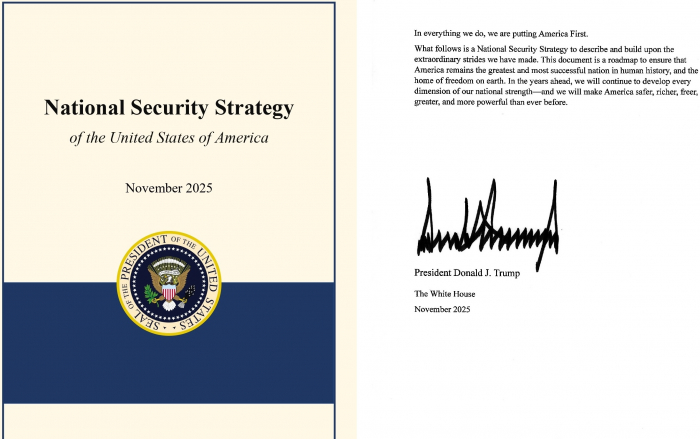
In November 2025, US President Trump signed and unveiled the new US National Security Strategy in Washington, an ambitious, detailed, and forthright plan designed to define what America wants from the world and how it intends to achieve it. The document suggests a new approach that moves away from unclear, overly ambitious ideas of global leadership and instead focuses on safeguarding America's interests, independence, and essential power. This document is not simply a declaration of intent but a clear strategic plan that "connects ends and means." The Strategy first provides a thorough analysis of what America wants (security, economic and technological strength, resilience, and cultural revival) and then what resources it is willing to mobilize—the economy, industry, technology, military force, and diplomatic and cultural tools.
The strategy clearly defines "national interests" not as abstract "defending democracy" or universal values, but as concrete objectives: from border control and protecting domestic stability to ensuring technological and energy independence, a strong industrial base, advanced scientific and technological leadership, and a strong military.
The strategy also addresses foreign policy, defining key regions and interests of the United States. These include the Western Hemisphere, the Indo-Pacific region, Europe, the Middle East, and Africa. The document articulates how America intends to influence the global order: through protecting its supply chains, ensuring freedom of navigation, the security of allies, technological competition, control over key strategic resources, and, in part, through cultural and civilizational influence.
The main goal of the Strategy is to secure the United States' status as the strongest, independent, and sovereign power capable of defending its interests. At first glance, it may seem that in this strategy, the United States no longer views itself as a global "policeman of the world" but as a leading nation that decides when to intervene and when to defend, when to expand influence and when to strengthen its own foundation.
The US strategy is built on the priority of national interests and the complete protection of its own supply chains, technologies, and resources. For countries in the Global South, this means that American economic and technological initiatives will be constrained by US interests, and access to key markets, advanced technologies, and strategic materials will be controlled and selective. China, as a leading technological and economic power, will come under increased pressure. Artificial US restrictions on the export of technology, intellectual property, and strategic materials will be aimed at slowing the development of Chinese projects in high-tech industries.
The US strategy emphasizes military power, deterring threats, and protecting allies in key regions—the Indo-Pacific, Europe, and the Western Hemisphere—with the goal of increasing geopolitical pressure on China and limiting its freedom of maneuver in strategically important regions where China is actively investing in infrastructure and trade. Countries in the Global South, dependent on external investment and technology, will inevitably find themselves forced to choose between supporting American interests or Chinese projects, which weakens their strategic autonomy.
The US strategy emphasizes maintaining soft power and cultural influence and promoting Western identity and civilizational values. This creates cultural and diplomatic pressure on countries in the Global South, reducing the attractiveness of their development models and limiting opportunities for promoting alternative approaches to education, governance, values, and global cooperation.
Link to document
https://www.whitehouse.gov/wp-content/uploads/2025/12/2025-National-Security-Strategy.pdf
P.S. GSR aims to conduct an in-depth and comprehensive analysis of the new US National Security Strategy 2025 and prepare a series of articles revealing its wide-ranging implications for countries in the Global South.

